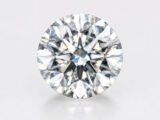
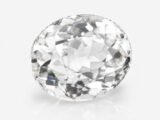
Worried about buying fake Sphatik? You’re not alone. The Indian market is flooded with inexpensive machine-molded glass sold as “original Sphatik” — and even experienced buyers get fooled. This guide teaches you exactly how to identify original Sphatik stone from fake glass using advanced scientific and simple home tests. Whether you’re buying for Shiva puja, japa mala, or as a substitute gemstone for Diamond, you’ll learn everything: authentication tests, physics properties, realistic prices, and what to check before purchasing.
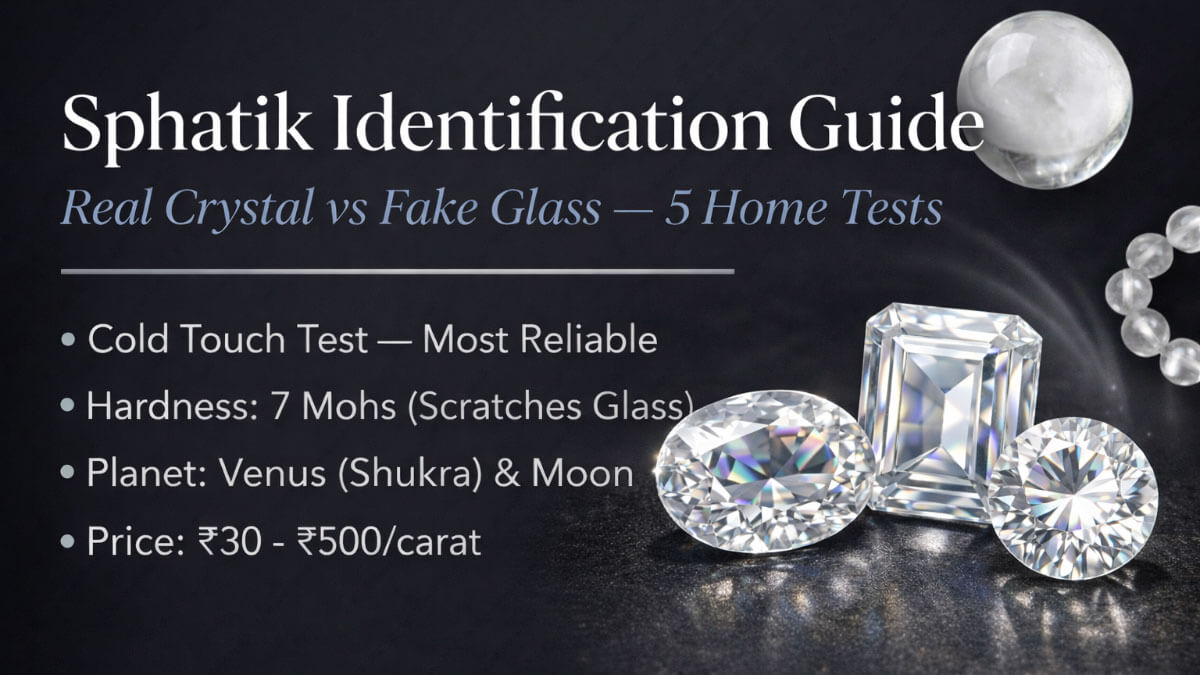
Quick Summary: Real Sphatik is crystalline alpha-quartz (hardness 7, specific gravity 2.65). It feels cold due to high thermal conductivity, scratches glass, and displays natural inclusions. Fake glass warms quickly, is softer (Mohs 5-6), and contains rounded air bubbles or strain shadows.
Sphatik Gemological Specifications
| Scientific Name | Clear Quartz / Rock Crystal (Alpha Quartz) |
| Chemical Formula | SiO₂ (Silicon Dioxide) |
| Crystal System | Trigonal (Low-temperature Alpha form, stable below 573°C) |
| Hardness | 7 on the Mohs Scale |
| Specific Gravity | 2.65 g/cm³ (Highly consistent) |
| Refractive Index | 1.544 – 1.553 (Uniaxial Positive, Birefringence +0.009) |
| Astrological Association | Venus (Shukra) and Moon (Chandra) |
| Primary Uses | Japa Mala, Shivling worship, Pitta cooling, Diamond substitute |
What is Sphatik Stone? (स्फटिक क्या है?)
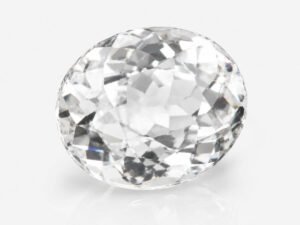
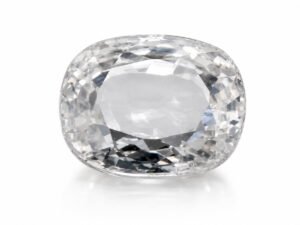
Sphatik is the traditional Sanskrit and Hindi name for natural Clear Quartz Crystal. It forms deep within the Earth’s crust over millions of years under hydrothermal pressure. Scientifically, it is a pure silicon dioxide crystal belonging to the trigonal crystal system. At temperatures above 573°C, it undergoes structural inversion into hexagonal beta-quartz, but all ambient specimens are trigonal alpha-quartz.
स्फटिक एक प्राकृतिक क्वार्ट्ज क्रिस्टल है जिसे अंग्रेजी में Clear Quartz या Rock Crystal कहते हैं। शिव पूजा, जप माला और वास्तु के लिए स्फटिक को अत्यंत शुभ माना जाता है।
Scientific Resonator & Timekeeping Physics
Quartz is not just a spiritual stone; it is the cornerstone of modern electronic frequency control due to two physical properties:
- Piezoelectricity: When mechanical pressure is applied to a Sphatik crystal, it generates a microscopic electrical charge. Conversely, when an electric current (such as from a battery) is passed through it, the crystal physically deforms and oscillates at a highly stable, precise frequency.
- Watch Timing: In quartz watches, a tiny tuning-fork-shaped slice of clear quartz is stimulated to vibrate exactly 32,768 times per second. A microchip counts these vibrations and ticks the watch forward exactly once every second.
- Pyroelectricity: Quartz also generates electrical polarization when subjected to temperature fluctuations.
Difference Between Sphatik and Glass
Because glass is chemically similar to quartz (amorphous silicon dioxide), sellers pass off inexpensive melted glass as natural Sphatik. Here is how to distinguish them:
Sphatik vs Glass Comparison
| Property | Original Sphatik | Fake (Glass) |
|---|---|---|
| Crystal Structure | Crystalline (Trigonal lattice) | Amorphous (Non-crystalline) |
| Thermal Conductivity | High (Feels icy cold, drains hand heat) | Low (Warms to skin temperature in seconds) |
| Polariscope Test | Uniaxial positive “Bull’s-Eye” optical figure | Isotropic (Stays completely dark) |
| Inclusions | Angular fractures, natural veils, rainbows | Round air bubbles, swirl lines |
| Hardness | 7 (Scratches window glass easily) | 5.5 (Cannot scratch other glass) |
| Triboluminescence | Rubbing two pieces together flashes cold sparks | No light emitted when rubbed |
How to Check if Sphatik is Original: 5 Home & Lab Tests
Test 1: The Triboluminescence Spark — Rough Specimens Only
Quartz is one of a small number of minerals that emits faint light when its structure is stressed. It is the same underlying property that makes quartz piezoelectric, and the reason quartz became the heart of every accurate clock. In a completely dark room, after letting your eyes adjust for two minutes, rubbing two pieces of rough quartz briskly together produces faint flashes of cold light and sometimes a sharp mineral smell. It is a real phenomenon and a memorable one to see.
Two honest caveats before you try it. First, never do this with cut stones, polished spheres or mala beads. Quartz is hard at Mohs 7 but brittle, with no cleavage to absorb a knock — striking two polished pieces together will chip girdles and bead holes, and you will have damaged the stone to prove a point that the next four tests prove without touching it. Second, the effect is faint and inconsistent even on rough material, so a specimen that shows nothing has not failed anything. Treat this as a curiosity rather than a diagnostic; Tests 2 to 5 are the ones that actually decide the question.
Test 2: The Cold Touch Test (High Thermal Conductivity)
Due to its high thermal conductivity, natural quartz absorbs and draws heat away from your skin. Hold a Sphatik bead tightly in your palm for 45 seconds, then immediately press it against your lips or cheek. If it is genuine, it will still feel cool. Fake glass will feel warm and match your body temperature.
Test 3: Polariscope “Bull’s-Eye” Figure (Lab Diagnostic)
Under a gemological polariscope, if you rotate a piece of natural quartz along its optic axis, it rotates polarized light to show a circular “bull’s-eye” interference figure (Uniaxial Positive). Glass is isotropic and remains completely dark, or displays irregular anomalous double refraction (ADR) strain shadows caused by quick cooling.
Test 4: Magnification and Bubble Test
Examine the stone under a 10x loupe. Natural Sphatik has internal growth “fingerprints” — microscopic fractures, liquid-filled veils, and faint rainbow reflections. Glass contains round, spherical air bubbles trapped during the melting process. Growth lines in glass are curved, whereas in natural quartz they are straight and follow crystal faces.
Test 5: Identifying Hydrothermal Synthetics
Some Sphatik in the market is synthetic quartz grown in hydrothermal autoclave chambers. While chemically identical to natural quartz, gemologists detect them under magnification by looking for a flat, planar seed plate near the center of the crystal, or a Chelsea filter showing a yellowish-green boundary shimmer. Advanced testing using FTIR spectroscopy isolates synthetic hydroxyl bands (such as the 3581 cm⁻¹ peak).
How to Identify Original Sphatik Mala
Sphatik malas (108 beads) are highly prone to glass mixing. Verify your mala beads:
- Weight Check: An authentic 108-bead Sphatik mala with 8mm beads should weigh approximately 50 to 60 grams. Glass is significantly lighter.
- Drill Hole Finish: Natural quartz is hard and drilled with diamonds, leaving clean, smooth entry holes. Glass beads drilled or molded show chipped, frosted, or white-colored fractures around the drill holes.
- Uniformity Check: Natural crystal malas exhibit slight variations in clarity, inclusion density, and color tone between beads. A mala where every bead is 100% identical and flawless is likely glass.
Sphatik Stone Price in India (2026)
Wholesale raw quartz is traded per kilogram, while gem-grade loose stones are priced per carat. Current rates in the Indian market:
Price Index per Carat (Loose Gemstone)
| Quality Grade | Price Range (₹/Carat) | Internal Clarity |
|---|---|---|
| Everyday Grade | ₹30 – ₹80 | Milky, heavily veiled, suitable for bulk beads |
| Fine Astrological | ₹80 – ₹200 | Semi-clear, minor veils, good polish |
| Premium Grade | ₹200 – ₹500 | Water-white transparency, eye-clean |
| Wholesale Quartz Clusters | ₹2,500 – ₹9,500 per kg | Rough Brazilian or Himalayan specimens |
Red Flag: If a seller offers a “natural clear” 108-bead Sphatik mala (8mm) for under ₹300, it is guaranteed to be glass. Genuine raw quartz crystal processing, diamond drilling, and polishing labor alone exceed this cost.
Sphatik in Ayurveda: The Sheetala Classification
Ayurvedic texts classify Sphatik as having Sheetala virya — cooling potency. Within that framework it sits among the substances associated with Pitta, the dosha linked to heat and intensity, which is why Sphatik malas have traditionally been preferred for japa in hot weather and why polished spheres are held or rested against the brow during meditation.
There is also a straightforwardly physical reason the stone feels the way it does. Quartz conducts heat away from skin far more readily than glass, so a Sphatik bead genuinely does feel cold in the hand and stays cool while you use it — the same property that makes the Cold Touch Test above work. The tradition and the physics happen to point the same way here, which is unusual and worth knowing.
This describes a traditional classification, not a medical claim. Sphatik does not treat any condition, and anything concerning your health belongs with a doctor rather than a gemstone.
Vedic Astrology: The “Sattvic” Diamond Substitute
Vedic astrology rules state that Sphatik is a powerful Up-ratna (astrological substitute) for Venus (Shukra) and is also connected to the Moon (Chandra). * Safe Alternative: While Diamonds are highly potent and can cause sudden energetic fluctuations if unsuitable, Sphatik is a Sattvic (neutral, pure) stone. It purifies the aura, bringing Shukra’s peace, creativity, and relationship harmony safely to any wearer. * The Carat to Ratti Formula: Traditional Indian astrologers prescribe weights in Ratti. 1 Ratti equals 0.91 Carats. If prescribed a 6 Ratti stone, look for a certified Sphatik weighing approximately 5.5 Carats. * Wearing Guidelines: Mount Sphatik in a silver ring (silver enhances its cooling nature). Purify the ring in Gangajal or raw cow’s milk on a Friday morning during Shukla Paksha, chanting the Venus mantra: *”Om Shum Shukraya Namah”* (ॐ शुं शुक्राय नमः) 108 times before wearing it on the middle or ring finger of your dominant hand.
Puranic Significance of Sphatik Shivling
The Shiva Purana and Linga Purana declare that worshiping a Sphatik Shivling is equivalent to worshiping Lord Shiva in His formless, infinite aspect (Nirguna Brahman). Because the crystal is colorless, it absorbs the colors of its surroundings, reminding devotees that the Supreme Soul is all-pervading and detached. Conducting Abhishekam (ritual washing with milk, honey, and water) on a Sphatik Shivling in the home is believed to eliminate Vastu faults and invite spiritual ascension.
How to Care for Sphatik
- Avoid Heat Shock: While quartz is relatively hard (hardness 7), sudden temperature changes can fracture the crystalline structure. Never wash it in boiling water.
- Chemical Exposure: Keep your Sphatik mala away from perfumes, hairsprays, and harsh floor cleaners. Clean it using only mild, soapy lukewarm water and a soft-bristled toothbrush.
- Astrological Cleansing: Recharge your Sphatik once a month by placing it under the light of a Full Moon overnight, or resting it on a natural amethyst cluster.
Why Buy Sphatik from Ratna Gems?
Every Sphatik from Ratna Gems comes with:
- Lab Certification: ISO-certified gemological lab reports with Lifetime Authenticity Guarantee.
- 100% Natural: No glass, no synthetic — only genuine quartz crystal.
- 7-Day Returns: Shop with confidence — full refund if not satisfied.
Frequently Asked Questions
What is the difference between Sphatik and glass?
Sphatik (natural quartz crystal) has hardness 7 on Mohs scale, feels permanently cool due to high thermal conductivity, and may contain natural inclusions. Glass has hardness 5-6, warms quickly to body temperature, and may contain round air bubbles. The cold touch test is the easiest way to differentiate — hold for 30 seconds, and real Sphatik will still feel cool.
How to identify original Sphatik stone at home?
Use these 5 tests: (1) Cold touch test — real Sphatik stays cool after holding; (2) Scratch test — Sphatik scratches glass; (3) Magnification test — look for natural inclusions, not air bubbles; (4) Weight test — Sphatik is heavier than glass of same size; (5) Lab certification for 100% confirmation.
Is Sphatik and crystal the same?
Yes, Sphatik is the Hindi/Sanskrit name for natural Clear Quartz crystal. It’s also called Rock Crystal, Crystal Quartz, Sfatik, or Spatik. All these names refer to the same natural silicon dioxide mineral (SiO₂).
Which planet is associated with Sphatik?
According to Vedic astrology traditions, Sphatik is primarily associated with Venus (Shukra) and also connected to Moon (Chandra). Some Jyotish practitioners recommend it as a substitute for Diamond. Consult a qualified astrologer for personalized recommendations.
What is the price of original Sphatik stone?
Original Sphatik price ranges from ₹30-80/carat (everyday grade) to ₹200-500/carat (premium clarity). A 108-bead Sphatik mala costs ₹400-2,500 depending on bead size and quality. Prices below these ranges typically indicate glass fakes.
How to check if Sphatik mala is original?
Run all beads through your fingers — all should feel cool. Look for slight natural variations between beads (glass is perfectly uniform). Examine drill holes — natural crystal has smooth holes, glass chips easily. Weigh the mala — authentic 8mm, 108-bead mala weighs 50-60 grams. Price under ₹200 is a red flag.
Can I wear Sphatik daily?
Yes, Sphatik is durable (hardness 7) and suitable for daily wear as mala, bracelet, or ring. Protect from hard impacts and store separately from harder gemstones like diamond or sapphire to prevent scratches.