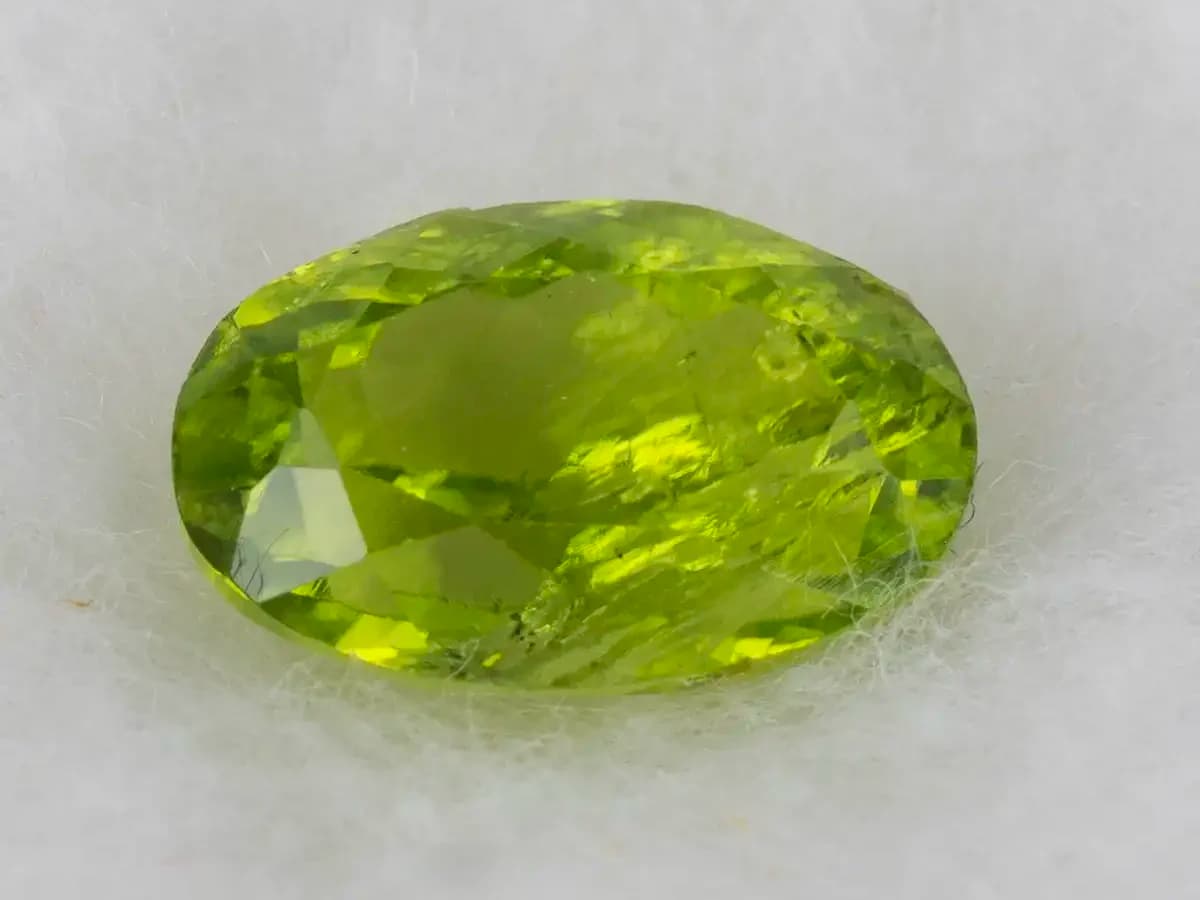
Natural Peridot Stone (Pakistan Sapat Valley) 3.57 Carat (3.92 Ratti) Oval Mix Cut
SKU: GS11240480702



Gemstone & Physical Specifications
Verified gemological characteristics and certified measurements.
- Weight
- 3.57 Carat (≈ 3.92 Ratti)
- Shape / Cut
- Oval Mix Cut
- Dimensions
- 11 x 7 x 6 mm
- Origin
- Indian
Detailed Product Description
Natural Peridot Stone (Pakistan Sapat Valley) – 3.57 Carat (3.92 Ratti) Oval Mix Cut
This Natural Peridot Stone (Pakistan Sapat Valley) weighs exactly 3.57 Carats (3.92 Ratti) with calibrated dimensions of 11 x 7 x 6 mm. Expertly faceted into a brilliant Oval Mix Cut, this Earth-mined gemstone displays a vibrant olive-to-lime green color with exceptional transparency, lively scintillation, and an attractive vitreous luster.
Mineralogical Identity & Physical Constants: Peridot is the gem-quality variety of Olivine (magnesium iron silicate, (Mg,Fe)2SiO4), specifically the forsterite end-member. Notably, Peridot is an idiochromatic gemstone: its distinctive yellowish-green to olive-green coloration is caused by intrinsic divalent iron (Fe2+) that forms an integral part of its chemical structure, rather than trace impurities. Under gemological testing, it exhibits a refractive index of 1.654 to 1.690 with strong diagnostic birefringence (0.036, displaying noticeable doubling of back facet junctions under 10x magnification), a specific gravity of 3.32 to 3.40, and a Mohs hardness of 6.5 to 7.0.
Geographical Origin & Cultural Legacy: Mined from the high-altitude alpine pegmatites of the Sapat Valley in Kohistan, Pakistan (situated over 4,000 meters in the Himalayas), Pakistani peridot is globally prized by gemologists for producing large, transparent, saturated olive-green crystals. Known in traditional Indian lapidary trades as Zabarjad (ज़बरजद) or Peridot Ratna, it has a revered history dating back over 3,500 years to ancient Egyptian mining on the Red Sea island of Zabargad (Topazios). In Vedic astrology, it is the primary secondary substitute (Upratna) for Natural Emerald (Panna) associated with Mercury (Budh). It is also celebrated worldwide as the official August birthstone. It is customarily mounted in Sterling Silver (925 Silver), Panchdhatu, or yellow gold for rings and pendants.
Please Note: Ratna Gems shares these historical, cultural, and gemological details solely for educational awareness. We sell all gemstones strictly on the basis of verified physical authenticity, mineral quality, and accredited laboratory certification, and make no astrological, metaphysical, or curative claims.
Care Instructions
- Clean gently with mild soap and lukewarm water, then dry with a soft microfiber cloth.
- Avoid ultrasonic cleaners and steam cleaning; peridot is sensitive to thermal shock and sudden temperature fluctuations.
- Avoid contact with strong household acids, harsh chemical cleaners, and abrasive scouring pastes.
- For regular ring wear, a protective bezel or prong setting is recommended, and the ring should be removed during heavy manual work.
Frequently Asked Questions
More from Peridot Stones

Natural Peridot Stone (Pakistan Sapat Valley) 4.53 Carat (4.98 Ratti) Oval Mix Cut

Natural Peridot Stone (Pakistan Sapat Valley) 3.64 Carat (4.00 Ratti) Oval Mix Cut

Natural Peridot Stone (Pakistan Sapat Valley) 8.24 Carat (9.05 Ratti) Oval Mix Cut

Natural Peridot Stone (Pakistan Sapat Valley) 7.35 Carat (8.08 Ratti) Oval Mix Cut
Customer Reviews
Verified feedback across our certified Peridot Stones collection. Because each natural gemstone is rare and one-of-a-kind, reviews reflect genuine patron experiences with this gemstone family.