Jamunia Stone Price & Buying Guide: Real vs Synthetic Amethyst (2026)
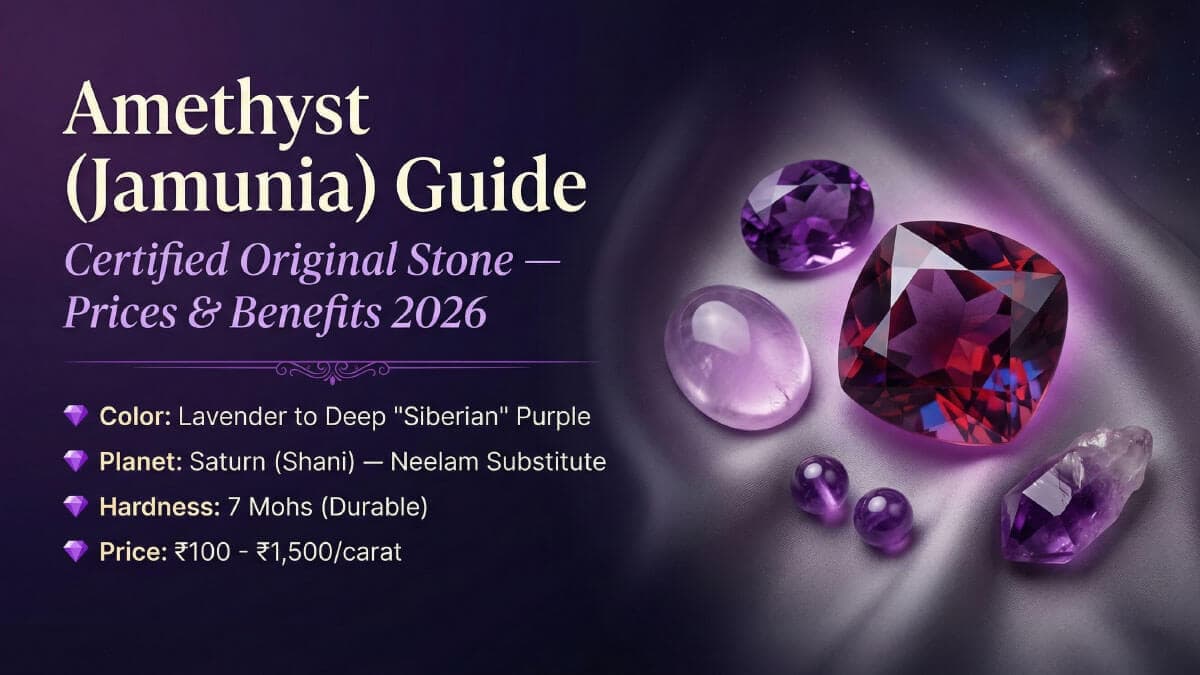
Jamunia is the Hindi name for Amethyst, the purple form of quartz, named after the Jamun fruit. In India it is bought mainly as an upratna for Blue Sapphire — a substitute stone worn for Saturn (Shani) — and it costs a small fraction of what Neelam does. There is one catch worth knowing before you buy: lab-grown amethyst is chemically identical to natural amethyst, so no home test will separate them. This guide covers what Jamunia costs per carat, how quality is graded, what a lab report actually needs to say, and how to work out the right ratti weight.
Jamunia Quick Facts
| Mineral Family | Quartz (SiO₂) |
| Color Cause | Iron impurities + natural irradiation |
| Hardness | 7 on Mohs Scale |
| Specific Gravity | 2.65 |
| Hindi Name | Jamunia (जामुनिया) |
| Astrological Association | Saturn (Shani) — Upratna for Blue Sapphire |
| Birthstone | February |
| Price Range (India) | ₹100 - ₹1,500 per carat |
What is Jamunia Stone (Amethyst)?
Jamunia is the Hindi name for Amethyst — the purple variety of quartz (SiO₂). It is named after the Jamun fruit, whose colour it resembles. In India it is bought mainly as a Saturn stone. The English name comes from the Greek amethystos, meaning "not intoxicated": the ancient Greeks believed it prevented drunkenness.
The purple comes from trace iron (Fe³⁺) sitting in place of silicon in the crystal. Natural radiation in the ground then converts some of that iron to Fe⁴⁺, creating the colour centres that make the stone purple. Amethyst is mined in many countries, and the main sources look different:
- Uruguayan Amethyst: Prized for its extremely deep, saturated violet color, high transparency, and red/blue dichroic flashes.
- Zambian Amethyst: Displays intense "raspberry" or "blueberry" purple saturation, though it is slightly more included.
- Brazilian Amethyst: Tends to be lighter (lilac to medium purple), often showing color zoning, and is mined in massive geodes.
Amethyst Color Grades
Color Quality Comparison
| Grade | Color Description | Trade Name | Value |
|---|---|---|---|
| AAA | Deep reddish-purple with red/blue flashes under daylight/incandescent light. | "Siberian" Amethyst | Highest |
| AA | Rich purple, even saturation throughout the stone. | Fine Amethyst | High |
| A | Medium purple, good saturation with minor zones. | Good Quality | Moderate |
| B | Light purple, may have visible color zoning. | "Rose de France" | Lower |
| C | Very pale, brownish, or grayish purple. | Commercial | Lowest |
Note on Siberian Grade: "Siberian Amethyst" originally referred to stones mined in Russia's Ural Mountains. Today, it is a trade grading term for any top-quality amethyst displaying deep violet color with strong reddish-purple and blue flashes.
Jamunia Stone Price in India (2026)
Understanding Amethyst stone price helps you buy well. Amethyst has an advantage most gemstones do not: the per-carat rate rises only gently with size, so a large stone with real presence is within reach where the equivalent sapphire or emerald would not be. It is one of the few gems where fine, fully saturated colour is available in large sizes rather than only in small ones.
Price by Quality Grade
| Quality | Price (₹/carat) | Color | Clarity |
|---|---|---|---|
| Everyday | ₹100 - ₹200 | Light purple, may have zoning | May have visible inclusions |
| Good | ₹200 - ₹400 | Medium purple, even color | Eye-clean |
| Fine | ₹400 - ₹800 | Rich purple, excellent saturation | Loupe-clean |
| Exceptional ("Siberian") | ₹800 - ₹1,500+ | Deep reddish-purple with red/blue flashes | Flawless |
Price by Origin
| Origin | Price Range (₹/carat) | Characteristics |
|---|---|---|
| Brazilian | ₹200 - ₹1,000 | Most common, wide quality range, often lighter |
| Uruguayan | ₹400 - ₹1,500 | Deep color, excellent saturation — premium quality |
| Zambian/African | ₹300 - ₹1,200 | Good color, often with reddish tones |
| Indian | ₹150 - ₹600 | Variable quality, good availability |
Amethyst Product Prices
| Product | Size/Specs | Price Range (₹) |
|---|---|---|
| Loose Amethyst Stone | 5-10 carat | ₹500 - ₹8,000 |
| Amethyst Ring (Silver) | 5-8 carat stone | ₹2,000 - ₹6,000 |
| Amethyst Pendant | 8-15 carat | ₹1,500 - ₹5,000 |
| Amethyst Bracelet | 8mm beads | ₹400 - ₹1,500 |
| Amethyst Mala (108 beads) | 6-8mm beads | ₹800 - ₹3,000 |
| Amethyst Geode | Small (500g-1kg) | ₹1,500 - ₹5,000 |
Prices as of January 2026. Actual prices vary based on color intensity, clarity, and origin.
What Affects Amethyst Price?
- Color Intensity: Deep reddish-purple ("Siberian") commands highest prices; pale lavender is least valuable
- Color Evenness: Uniform color is more valuable than stones with color zoning (patches)
- Clarity: Eye-clean is expected; visible inclusions reduce value
- Cut Quality: Well-cut stones maximize color and brilliance
- Size: Unlike most gems, large Amethyst isn't proportionally more expensive — great value in big stones
- Treatment: Most amethyst on the market is heated to even out the colour. Stones with strong natural colour and no heat command a premium.
How to Identify Original Jamunia (Amethyst)
Because amethyst is a variety of quartz, synthetic (lab-grown hydrothermal) amethyst is chemically, structurally, and optically identical to natural amethyst. Standard visual or thermal tests are insufficient to distinguish between them, making lab certification essential.
Important Disclaimer: Simple physical tests will identify glass and plastic imitations, but they CANNOT reliably detect hydrothermal synthetics. Always request a professional laboratory report to verify natural origin.
Test 1: Color Zoning Check
Natural amethyst often shows colour zoning — uneven, angular patches of purple that follow the crystal's growth structure. Place the stone face-down on white paper under soft light and look for it.
- What zoning tells you: Angular zones point towards natural growth. Bands running dead straight and parallel can indicate a synthetic seed plate.
- What it does not tell you: Even colour is not a warning sign. Fine natural amethyst is often evenly coloured, and that is the more desirable and more expensive material. Modern synthetics can also be grown with zoning. Treat this as a hint, never as proof.
Test 2: Touch & Hardness Tests
Real quartz behaves differently than glass or plastic:
- Temperature: Real quartz has high thermal conductivity; it feels cool to the touch and takes a long time to warm up in your palm. Plastic feels warm immediately.
- Hardness: Real Amethyst (Mohs 7.0) will easily scratch ordinary window glass (5.5) and cannot be scratched by a steel nail or copper coin. Glass fakes will not scratch glass easily.
Test 3: Microscopic Inclusion Check (10x Loupe)
Under a 10x jeweler's loupe or a microscope, search for characteristic natural inclusions:
- Goethite Needles: Golden-brown or reddish-brown branching needles, often radiating in bundles like small brooms. These sprays are widely sold in the trade as "cacoxenite", though in most amethyst they are goethite.
- Hematite Platelets: Reflective metallic plates or red specks trapped during natural growth.
- "Tiger Stripes": Rippled polysynthetic twinning lines (Brewster fringes) visible under crossed polarized filters.
- Synthetic Indicators: Hydrothermal synthetic stones are often flawless, containing tiny "bread-crumb" silica particles or straight, flat seed-plate lines. Glass fakes contain spherical air bubbles and curved swirl lines.
Test 4: GIA FTIR Spectroscopy (The Only 100% Reliable Method)
Synthetic amethyst matches natural quartz in refractive index (1.544–1.553) and density (2.65), so those readings tell you nothing. Labs use FTIR — Fourier-Transform Infrared Spectroscopy — instead. Natural amethyst shows a sharp absorption band at 3595 cm⁻¹. In hydrothermal synthetics that band is either missing or far broader. This is the test that actually settles the question, and it is why a report matters more with amethyst than with most stones.
Critical Point: For astrological Saturn remedies, the gemstone must be natural and untreated. Insist on a certificate from a government-recognized gemological lab verifying the stone as "Natural Quartz" and confirming it has no hydrothermal indicators.
Jamunia in Vedic Astrology
According to Vedic astrology traditions, Jamunia (Amethyst) is considered an Upratna (substitute gemstone) for Blue Sapphire (Neelam). Both are associated with Saturn (Shani).
Who May Consider Wearing Jamunia?
As per traditional Jyotish recommendations:
- Those advised toward Saturn who want to begin with a gentler stone
- People wanting to "test" Saturn energy before wearing Neelam
- Individuals with Capricorn (Makar) or Aquarius (Kumbh) ascendant
- Those undergoing Saturn Mahadasha or Sade Sati
- Anyone seeking Saturn's blessings for discipline, focus, and patience
Traditional Astrological Symbolism of Jamunia
In Vedic astrology, Jamunia is associated with the qualities of Saturn (Shani). Traditional beliefs associate it with:
- Discipline and self-control, in keeping with Saturn's character
- Patience and a steady approach to long-term work
- Focus during meditation and study
- Protection, in the traditional sense in which Saturn stones are worn
- Spiritual awareness and inner steadiness
Traditional Wearing Guidelines
| Recommended Weight | 5 to 8 Ratti (approx. 4.5 to 7.5 Carats) based on body weight |
| Finger | Middle finger of the dominant hand (right hand for right-handers) |
| Metal | Silver or Panchdhatu |
| Day to Wear | Saturday evening, during Shukla Paksha (waxing moon phase) |
| Mantra | "Om Sham Shanicharaya Namah" (ॐ शं शनिचराय नमः) — 108 times |
| Cleansing | Cleanse with Gangajal or raw cow's milk before wearing |
Determining the Correct Carat and Ratti Weight: For astrological remedies, a general rule of thumb followed in India is wearing 1 Ratti of gemstone weight for every 10 kg of body weight (e.g., if you weigh 60 kg, you should wear a 6 Ratti stone). Since 1 Ratti is equivalent to 0.91 Carats, you can calculate the corresponding weight in Carats (1 Carat ≈ 1.09 Ratti). It is essential to ensure that your natural Jamunia stone is untreated and certified, as quality is always more crucial than size alone.
Note: Astrological recommendations vary based on individual birth charts. Please consult a qualified Jyotish practitioner before wearing any gemstone for astrological purposes. As a Saturn substitute, Jamunia is considered gentler than Neelam but still requires proper guidance.
How to Evaluate Amethyst Quality
Amethyst quality is evaluated similarly to other colored gemstones:
1. Color (70% of value)
- Best: Deep reddish-purple with red and blue secondary flashes ("Siberian")
- Good: Rich, saturated purple
- Average: Medium purple
- Lower: Light lavender ("Rose de France") or brownish/grayish purple
2. Clarity (15% of value)
- Best: Loupe-clean (no inclusions under 10x magnification)
- Good: Eye-clean (no inclusions visible to naked eye)
- Lower: Visible inclusions
Because Amethyst is abundant, eye-clean stones are expected. Don't accept visible inclusions.
3. Cut (10% of value)
- Should maximize color saturation
- Good symmetry and proportions
- Minimize color zoning visibility
- No windowing (light areas where you see through)
4. Carat Weight (5% of value)
- Unlike most gems, large Amethyst is readily available
- Price per carat doesn't increase dramatically with size
- Large, impressive stones are readily obtainable in fully saturated colour
How to Care for Amethyst Jewelry
Although Amethyst has a Mohs hardness of 7.0, it is sensitive to heat, light, and physical stress due to its internal inclusions:
Critical Warning: Long exposure to direct sunlight or high heat breaks down the iron colour centres in amethyst, and the purple fades permanently. It does not come back. Keep Jamunia jewellery in a drawer or box, away from windows and dashboards.
- Cleaning: Clean only with lukewarm, mild soapy water and a soft-bristled brush. Rinse thoroughly and dry with a lint-free cloth.
- Avoid Ultrasonics: Never clean amethyst in an ultrasonic or steam cleaner. The vibrations stress the planes around internal goethite or hematite needles, and the stone can crack.
- Chemicals: Avoid contact with bleach, ammonia, cosmetics, and perfumes, which can etch the surface polish.
- Storage: Store separately in a cloth pouch. Harder gems like Ruby, Sapphire, or Diamond can scratch Amethyst easily.
Buying Checklist: Original Jamunia
Before purchasing, verify:
- ✓ Rich, saturated purple color (not pale or brownish)
- ✓ Eye-clean clarity (no visible inclusions)
- ✓ No air bubbles visible under magnification
- ✓ Cannot be scratched by steel (hardness test)
- ✓ Lab certification confirming "Natural Amethyst" (essential for natural vs synthetic)
- ✓ Seller discloses any treatments (heat treatment is common and acceptable)
- ✓ Return policy offered
For comprehensive gemstone evaluation guidance, see our complete gemstone buying guide.
Why Buy Jamunia from Ratna Gems?
Every Amethyst from Ratna Gems comes with:
- Lab Certification: Natural Amethyst certified — not synthetic — with Lifetime Authenticity Guarantee.
- Photographed As It Is: Every stone shot under neutral light, so the colour you see is the colour that arrives.
- 7-Day Returns: Shop with confidence — full refund if not satisfied.
Frequently Asked Questions
What is Jamunia Ratna?
Jamunia Ratna is the Hindi name for Amethyst — a purple variety of quartz. The name comes from its resemblance to Jamun fruit (Indian Blackberry). According to Vedic astrology traditions, it's considered an Upratna (substitute) for Blue Sapphire and is associated with Saturn (Shani).
What is Amethyst stone price in India?
Amethyst stone price in India ranges from ₹100-200/carat for commercial quality to ₹800-1,500/carat for exceptional "Siberian" quality with deep reddish-purple color. Unlike most gems, large Amethyst stones don't cost proportionally more, so a large stone in fine colour is genuinely obtainable rather than a compromise.
How to identify original Amethyst from synthetic?
You cannot, by eye. Synthetic amethyst is chemically identical to natural amethyst, so refractive index, density and hardness all read the same. Angular colour zoning hints at natural growth, but even colour is not a warning sign — fine natural amethyst is often evenly coloured, and that is the better material. Only a lab report, using FTIR spectroscopy, settles the question. Insist on one if the stone is for astrological use.
Is Jamunia a substitute for Blue Sapphire?
According to Vedic astrology traditions, Jamunia (Amethyst) is considered an Upratna (substitute) for Blue Sapphire (Neelam). Both are associated with Saturn. Jamunia is considered gentler and is sometimes recommended for those who prefer to approach Saturn gradually, or who want to work with an upratna before the primary stone. Consult an astrologer for guidance.
Can Amethyst color fade?
Yes, Amethyst color can fade permanently if exposed to prolonged direct sunlight or high heat. Always store Amethyst jewelry away from windows and sunlight. This is one of the few gemstones where sun exposure is a genuine concern.
Which finger should Jamunia be worn on?
According to traditional Vedic astrology guidelines, Jamunia is worn on the middle finger of the right hand (or left hand for women), set in silver or Panchdhatu, on Saturday evening during Shukla Paksha. The Shani mantra "Om Sham Shanicharaya Namah" is chanted 108 times before wearing. Consult an astrologer for personalized guidance.
How many Carats or Ratti of Jamunia should I wear?
For astrological purposes, the recommended weight of an original Jamunia stone is typically 1 Ratti for every 10 kg of your body weight. For example, if you weigh 70 kg, a 7 Ratti stone (approx. 6.4 Carats) is suitable. Make sure to purchase a natural, certified stone that is clean and free of harsh treatments.
Is Amethyst suitable for daily wear?
Yes, Amethyst (hardness 7) is durable enough for daily wear in rings and bracelets. However, protect from direct sunlight (color can fade), remove during heavy work, and store separately from harder gemstones like sapphire or diamond.
Looking for 100% Original Certified Gemstones?
Explore our lab-tested inventory of natural Ceylon Sapphires, Zambian Emeralds, Burmese Rubies, and Original Nepali Rudrakshas with official certificate.