Hakik Stone Buying Guide: Varieties, Price and How to Spot Dyed Agate

Agate is known in India as Hakik or Akik. It is a banded form of chalcedony quartz, and one of the most widely worn gemstones in India. The two varieties Indian buyers ask for most are Sulemani Hakik, the black-and-white banded stone, and Yamini Hakik, the deep red one. Agate is easy to dye, so knowing how to spot treated stones matters more here than with most gems. This guide covers how to tell natural Hakik from dyed and imitation stones, what each grade costs per carat, how to work out the right ratti weight, and what to check before you buy.
Agate (Hakik) Specifications
| Chemical Composition | Silicon Dioxide [SiO₂] (cryptocrystalline chalcedony quartz) |
| Mineral Species | Quartz Group (Trigonal crystal system) |
| Mohs Hardness | 6.5 – 7.0 (Highly durable for daily wear) |
| Specific Gravity | 2.58 – 2.64 |
| Refractive Index | 1.530 – 1.543 |
| Birefringence | Up to 0.004 |
| Typical Features | Concentric colour banding, quartz plumes, iron dendrites (common, but not proof of natural colour) |
| Planetary Rulers | Saturn & Rahu (Sulemani), Mars (Yamini/Red), Jupiter (Yellow), Mercury (Green), Moon & Venus (White) |
Understanding the Varieties of Hakik Stone
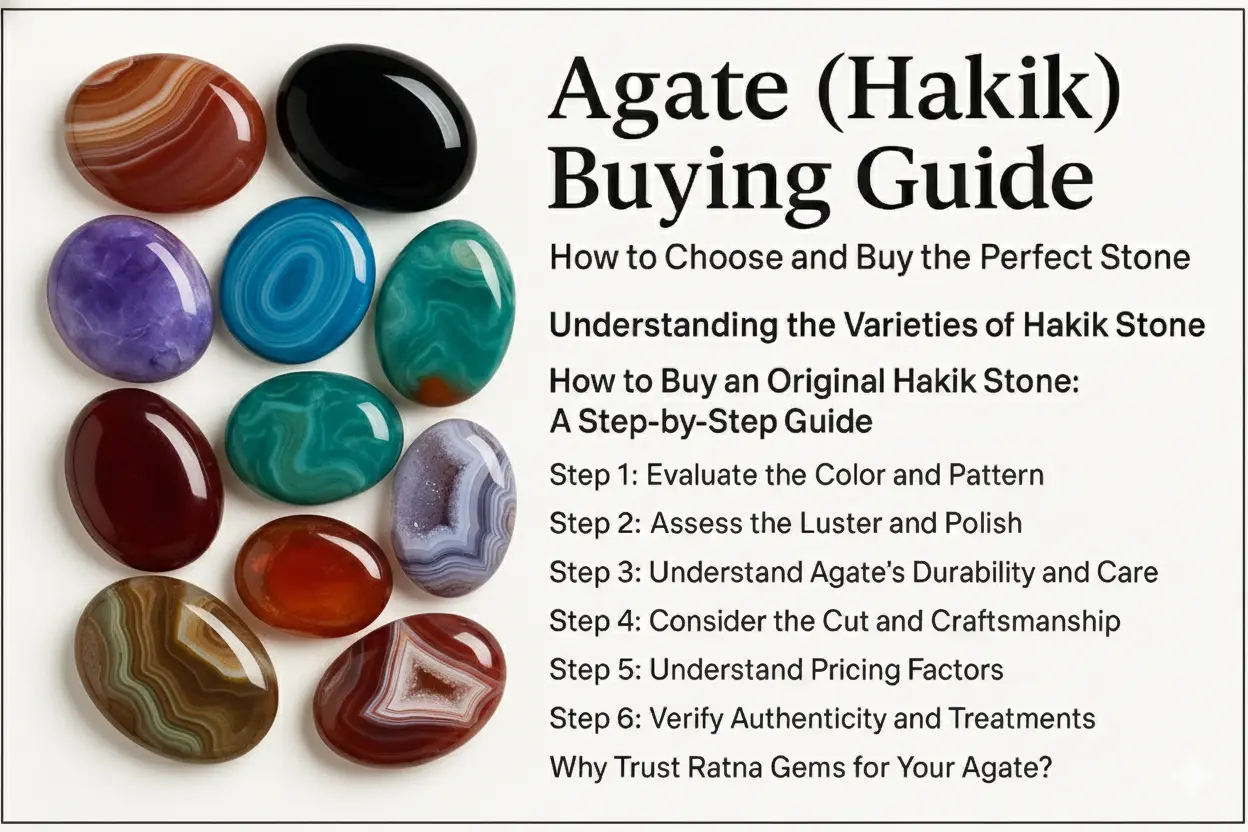
Agate is not one stone but a family of banded chalcedony varieties. Knowing which is which is the first step in choosing well. These are the types Indian buyers ask for most:
- Sulemani Hakik (Black Agate): Solid black or dark brown, usually with sharp white or grey bands in concentric rings — the "eye" pattern it is known for. In Vedic practice, Sulemani Hakik is the stone traditionally worn for Saturn (Shani) and Rahu, and is the variety most often chosen against Nazar Dosh.
- Yamini Hakik: A rich liver-red, cherry-red or deep orange-brown stone. The name comes from the Yemeni trade, though a stone should only be described as Yemeni if its source is documented. Yamini Hakik is traditionally worn for Mars (Mangal).
- Yellow Hakik (Pila Hakik): Traditionally worn for Jupiter (Guru), and used as an upratna — a substitute — for Yellow Sapphire.
- Green Hakik (Hara Hakik): Traditionally worn for Mercury (Budh), and used as an upratna for Emerald.
- Red Hakik (Lal Hakik): Traditionally worn for Mars (Mangal), like Yamini but usually a brighter, less brownish red.
- White Hakik (Safed Hakik): Traditionally worn for the Moon (Chandra) and Venus (Shukra).
Sulemani and Yamini are by far the most widely available. Yellow, green, red and white Hakik are stocked less often, and much of the brightly coloured material sold under those names is dyed. Buyers usually choose a variety on an astrologer's advice.
How to Buy an Original Hakik Stone: A Step-by-Step Guide
Step 1: Evaluate the Color and Spot Dye Treatments
Chemical dyeing is extremely common in agate due to its microcrystalline porosity. Commercial stones with "electric" neon pinks, bright purples, or synthetic greens are artificially dyed. Natural, undyed Hakik displays earthy, muted, organic colors. Under 10x magnification, check for dye concentration in tiny surface fractures, pores, and cracks where the dye collects in dark spiderweb patterns.
Step 2: Spot Fake Glass and Plastic Imitations
Three checks you can do yourself before sending a stone to a lab:
- Temperature Test: Agate carries heat away from your skin, so it feels cold when you first pick it up and warms slowly in your palm. Plastic feels warm straight away.
- Hardness Test: Agate is Mohs 6.5 to 7, so it will scratch ordinary window glass, which is about 5.5. Plastic is far softer and a steel pin marks it easily. Note that steel will not mark glass, so this test separates agate from plastic but not from glass — use the bubble check for that.
- Bubble Check: Under a 10x loupe, glass usually shows perfectly round trapped air bubbles and swirl lines. Agate shows banding and mineral patterns instead. Weight is not a reliable test here: agate and glass have almost the same density, so a fake will not feel noticeably lighter.
Step 3: Understand Cut, Luster and Polish
Agate is almost always cut as cabochons (smooth domes) or beads to display its internal banding and waxy-to-vitreous luster. High-quality polish should leave the cabochon surface smooth, without pits, cracks, or dull patches.
Step 4: Astrological Sizing & Wearing Rules
For Vedic remedies, the size of your Hakik ring or pendant must align with planetary energy transmission. To activate the stone, follow this guide:
Astrological Wearing Rules for Agate (Hakik)
| Vedic Sizing Formula | Wear approximately 1 Ratti for every 10 kg of body weight (e.g., a 70 kg individual requires a 7 Ratti stone). At the standard conversion of 1 Ratti = 0.91 carat, that is a 6.37 carat stone. |
| Sulemani Hakik (Saturn/Rahu) | Set in a Silver ring. Worn on the middle finger (Madhyama) of the dominant hand on a Saturday morning. Purify in raw milk and Ganga Jal, then chant Shani mantra 108 times: "Om Sham Shanicharaya Namah". |
| Yamini / Red Hakik (Mars) | Set in Silver or Copper. Worn on the ring finger (Anamika) on a Tuesday morning. Chant Mars mantra: "Om Ang Angarkaya Namah". |
| Yellow Hakik (Jupiter) | Set in Gold or Brass. Worn on the index finger (Tarjani) on a Thursday morning. Chant Guru mantra: "Om Brim Brihaspataye Namah". |
| Green Hakik (Mercury) | Set in Silver. Worn on the little finger (Kanishtha) on a Wednesday morning. Chant Mercury mantra: "Om Budhaya Namah". |
Step 5: Hakik Stone Price per Carat in 2026
Hakik is one of the most accessible gemstones you can own, but the range is wider than people expect and it is driven by pattern and finish, not by variety. A stone with a clean central eye or strong even banding costs several times what plain material does. Dyed stones sit at the bottom of the range. Note that a low price does not by itself mean a stone is dyed — plain natural Sulemani is genuinely inexpensive. Use this as a guide:
Hakik Price per Carat (2026)
| Grade | What You Get | Price Range (Per Carat) |
|---|---|---|
| Dyed | Colour added chemically. Uniform bright or neon shades, banding weak or missing. Sold as agate, but the colour is not the stone's own. | ₹50 – ₹150 |
| Natural, Standard | Undyed Sulemani or Yamini with everyday banding. Good polish, sometimes minor surface pits. | ₹90 – ₹350 |
| Natural, Premium | Strong even banding or a clear, well-centred "eye". Clean polish, good symmetry. | ₹350 – ₹800 |
| Collector | Exceptional eye or landscape patterns, hand-cut cabochons, matched pairs. | ₹800 – ₹3,000+ |
Step 6: Demand a Gemstone Laboratory Certificate
Always demand an independent lab report confirming the stone is "Natural Chalcedony" (or Natural Agate) and verifying that it is undyed and untreated. This rules out dyed common quartz and moulded glass sold under the same name.
Step 7: Purchase from a Reputable Seller
Ask two direct questions before you pay. First: is the colour natural, or has the stone been dyed? Second: what exactly does the report say? Watch for the common evasion here — a seller who answers only "it is natural agate" has not answered you, because dyed agate is still natural agate. The colour is what was added, not the stone. Also check that the return window is long enough for you to have the stone looked at independently if you want to.
Why Trust Ratna Gems™ for Your Agate?
At Ratna Gems™, we celebrate the natural beauty of every gemstone and are committed to providing only authentic, high-quality pieces. We are your trusted source because we offer:
- Natural and Undyed: Our Sulemani and Yamini Hakik are natural, untreated and undyed, and every stone comes with a lab report and a Lifetime Authenticity Guarantee.
- Transparent and Honest Pricing: We offer competitive prices for genuine Agate with full disclosure on quality and treatments.
- Unmatched Customer Support: Our experts are here to guide you, and our 7-day return policy ensures your complete satisfaction.
Frequently Asked Questions
Which planet is Hakik worn for?
It depends on the variety. In Vedic practice, Sulemani Hakik is the stone traditionally worn for Saturn (Shani) and Rahu, and is the variety most often chosen against Nazar Dosh. Yamini and Red Hakik are worn for Mars (Mangal), Yellow Hakik for Jupiter (Guru), Green Hakik for Mercury (Budh), and White Hakik for the Moon (Chandra) and Venus (Shukra). Buyers usually choose on an astrologer's advice.
How can I identify a dyed Agate (Hakik) stone?
Dyed Agates display unnaturally vivid, bright, or neon colors (like hot pink, bright purple, or electric green). Under a 10x magnification lens, you will see concentrations of dye settled inside surface cracks, pits, and fractures in a spiderweb pattern.
What are the differences between real Agate, plastic, and glass fakes?
Real agate feels cold when you pick it up and warms slowly in the hand, and it scratches ordinary window glass because it is Mohs 6.5 to 7. Glass fakes show round trapped air bubbles and swirl lines under a 10x loupe. Plastic feels warm straight away and a steel pin will mark it. Weight will not help you here — agate and glass have almost the same density, so a fake does not feel lighter.
Which finger and metal should I use to wear a Sulemani Hakik ring?
A Sulemani Hakik ring should be set in sterling silver and worn on the middle finger (Madhyama) of your dominant hand on a Saturday morning just after sunrise during the Shukla Paksha phase.
How do I calculate the correct Hakik weight for my body weight?
The standard Vedic rule is to wear 1 Ratti for every 10 kg of body weight. For instance, a 70 kg individual requires a stone of at least 7 Ratti, which translates to approximately 6.37 Carats (using the conversion formula: 1 Pukka Ratti = 0.91 Carats).
Looking for 100% Original Certified Gemstones?
Explore our lab-tested inventory of natural Ceylon Sapphires, Zambian Emeralds, Burmese Rubies, and Original Nepali Rudrakshas with official certificate.


