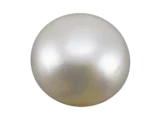
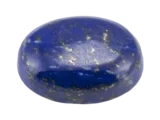
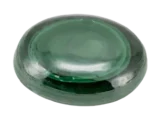
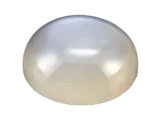
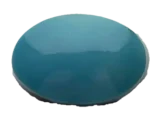
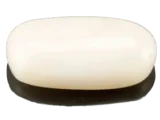
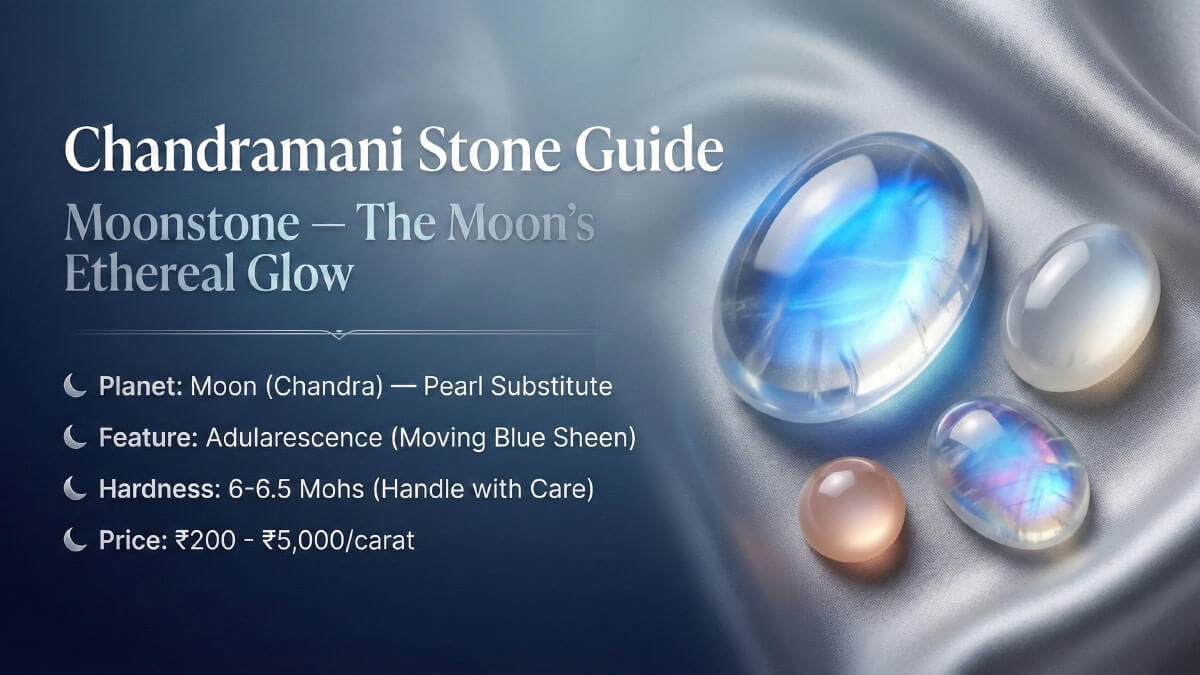
Looking for an authentic Chandramani stone? Moonstone — with its mystical, moon-like glow called adularescence — is one of the most beautiful and affordable gemstones associated with lunar energy. As an Upratna (substitute) for Pearl (Moti), it’s worn to harness calming Moon energies at a fraction of Pearl’s cost. But many buyers end up with Opalite (glass) instead of real Moonstone. This guide covers everything about Moonstone: current prices in India, how to identify genuine stones from fakes, what Vedic astrology says about its benefits, and how to evaluate quality.
Chandramani Quick Facts
| Mineral Family | Feldspar (Orthoclase or Oligoclase) |
| Chemical Formula | KAlSi₃O₈ (Orthoclase) |
| Hardness | 6 – 6.5 on Mohs Scale |
| Specific Gravity | 2.56 – 2.62 |
| Key Feature | Adularescence (moving sheen) |
| Hindi Name | Chandramani (चंद्रमणि) |
| Astrological Planet | Moon (Chandra) — Upratna for Pearl |
| Price Range (India) | ₹200 – ₹5,000+ per carat |
What is Chandramani Stone (Moonstone)?
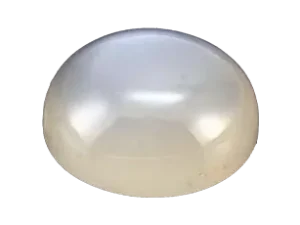
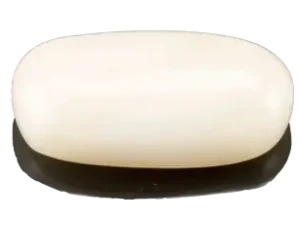
Chandramani (meaning “Moon Jewel” in Sanskrit) is the Indian name for Moonstone — a feldspar mineral famous for its ethereal, floating glow called adularescence. This billowy, bluish-white light appears to move just beneath the stone’s surface as you tilt it, resembling moonlight on water.
The optical phenomenon occurs due to the stone’s internal structure — alternating layers of orthoclase and albite feldspar that scatter light, creating the characteristic sheen.
Types of Moonstone
Moonstone Varieties
| Type | Sheen Color | Body Color | Value |
|---|---|---|---|
| Blue Sheen Moonstone | Blue (most prized) | Colorless/transparent | Highest |
| White Sheen Moonstone | Silvery white | Translucent white | Moderate |
| Rainbow Moonstone | Multi-colored flash | White/translucent | Moderate-High |
| Peach/Pink Moonstone | White to peachy | Peach/pink body | Moderate |
| Gray Moonstone | White sheen | Gray body | Lower |
Note: “Rainbow Moonstone” is technically a different mineral (labradorite feldspar) but is sold under the moonstone name due to its similar appearance. For astrological purposes, true orthoclase Moonstone (Chandramani) is preferred.
Chandramani Stone Price in India (2026)
Understanding Moonstone price helps you buy wisely and identify suspicious deals:
Price by Quality Grade
| Quality | Price (₹/carat) | Sheen | Body |
|---|---|---|---|
| Commercial | ₹200 – ₹500 | Weak/diffused white sheen | Milky, cloudy |
| Good | ₹500 – ₹1,500 | Visible white/silver sheen | Semi-translucent |
| Fine | ₹1,500 – ₹3,000 | Strong blue sheen | Translucent, few inclusions |
| Exceptional | ₹3,000 – ₹5,000+ | Vivid blue sheen, centered | Transparent, clean |
Price by Origin
| Origin | Price Range (₹/carat) | Characteristics |
|---|---|---|
| Sri Lanka (Ceylon) | ₹1,500 – ₹5,000+ | Finest quality, transparent body, vivid blue sheen — most valued |
| India | ₹500 – ₹2,500 | Good quality, often milkier body, white/silver sheen |
| Madagascar/Tanzania | ₹800 – ₹3,000 | Good blue sheen, variable transparency |
Moonstone Product Prices
| Product | Size/Specs | Price Range (₹) |
|---|---|---|
| Loose Moonstone (astrological) | 3-5 carat | ₹600 – ₹15,000 |
| Moonstone Ring (Silver) | 3-5 carat stone | ₹2,000 – ₹8,000 |
| Moonstone Pendant | 5-8 carat | ₹1,500 – ₹6,000 |
| Moonstone Bracelet | 8mm beads | ₹500 – ₹2,500 |
| Rainbow Moonstone Jewelry | Various | ₹800 – ₹5,000 |
Prices as of January 2026. Actual prices vary based on sheen quality, transparency, and origin.
What Affects Moonstone Price?
- Adularescence Quality: Strong, vivid blue sheen commands highest prices — this is the primary value factor
- Body Transparency: Colorless, transparent body is most valuable; milky/cloudy bodies are less valued
- Sheen Coverage: Centered sheen visible from multiple angles is premium
- Size: Price per carat increases significantly above 5 carats for fine quality
- Origin: Sri Lankan Moonstone commands highest prices
- Clarity: Fewer inclusions = higher price
How to Identify Original Chandramani (Moonstone)
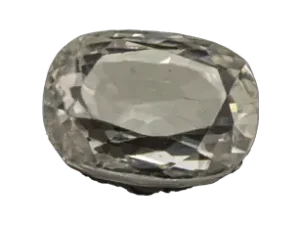
The most common Moonstone imitation is Opalite — a man-made glass that many sellers pass off as real Moonstone. Here’s how to tell them apart:
Important Disclaimer: The following self-tests are for preliminary analysis only. They help identify obvious fakes but cannot guarantee authenticity with 100% certainty. For definitive identification, always obtain a lab certificate from a recognized gemological laboratory.
Test 1: The Movement Test (Most Important)
This is the key difference between real Moonstone and Opalite.
How to test:
- Hold the stone under a light source
- Slowly tilt and rotate the stone
- Observe how the sheen behaves
Preliminary results:
- Real Moonstone: The sheen MOVES across the surface as you tilt — it’s directional and follows the light
- Opalite (Glass): The glow is STATIC — it doesn’t move, just has a uniform milky appearance
Why it works: Real adularescence is created by light scattering between internal crystal layers. It’s always directional. Opalite’s glow comes from uniform light diffusion in glass — it can’t mimic the movement.
Test 2: Clarity Observation
Examine the stone’s internal appearance:
- Real Moonstone: Natural inclusions possible, may show internal layering, sheen appears to float INSIDE the stone
- Opalite: Uniformly milky/opalescent, no internal structure, glow appears on the surface
Test 3: Temperature Test
Natural minerals conduct heat differently than glass.
Preliminary results:
- Real Moonstone: Feels cool, warms slowly
- Opalite (Glass): Also feels cool initially — this test alone cannot distinguish them
Test 4: Air Bubble Check
Under 10x magnification:
- Real Moonstone: No round air bubbles; may show natural inclusions or internal layering
- Opalite (Glass): May contain tiny round air bubbles (manufacturing defect)
Test 5: Lab Certification (100% Reliable)
For valuable purchases or astrological use, always get a lab report confirming:
- Material: Natural Feldspar (Orthoclase or Oligoclase)
- Phenomenon: Adularescence
- Treatment: Usually none expected
Remember: The movement test catches most Opalite fakes. But for expensive purchases or astrological purposes, professional lab testing is the only 100% accurate method.
Chandramani in Vedic Astrology
According to Vedic astrology (Jyotish), Chandramani is the Upratna (substitute gemstone) for Pearl (Moti). Both are associated with the Moon (Chandra), which governs mind, emotions, mother, and mental peace.
Who May Consider Wearing Chandramani?
As per traditional Jyotish recommendations:
- Individuals with weak or afflicted Moon in their birth chart
- Those seeking emotional balance and mental peace
- Cancer (Karka) ascendant — Moon is the ruling planet
- Scorpio (Vrishchika) and Pisces (Meena) ascendants may also benefit
- People who cannot afford quality Pearl
Traditional Benefits Associated with Chandramani
According to astrological practitioners, wearing Chandramani may support:
- Emotional stability and mental calmness
- Control over anger and mood swings
- Enhanced intuition and creativity
- Better sleep and peaceful mind
- Harmonious relationships, especially with mother
- Feminine energy balance
Traditional Wearing Guidelines
| Recommended Weight | 3-5 carats minimum |
| Finger | Little finger (right hand) |
| Metal | Silver (preferred — corresponds to Moon) |
| Day to Wear | Monday evening, Shukla Paksha |
| Mantra | “Om Chandraya Namah” (ॐ चंद्राय नमः) — 108 times |
| Cleansing | Gangajal or raw cow’s milk before wearing |
Note: Astrological recommendations vary based on individual birth charts. Please consult a qualified Jyotish practitioner before wearing any gemstone for astrological purposes. Moon is a gentle planet, but proper guidance ensures best results.
How to Evaluate Moonstone Quality
Unlike transparent gems graded by 4Cs, Moonstone quality depends primarily on its optical phenomenon:
1. Adularescence (60% of value)
- Best: Vivid blue sheen, centered on dome, visible from multiple angles
- Good: Strong white/silver sheen, well-centered
- Average: Diffused sheen, off-center or weak
- Poor: Barely visible or no sheen
2. Body Transparency (25% of value)
- Best: Colorless and transparent (like glass)
- Good: Translucent with slight color
- Average: Semi-translucent, milky
- Lower: Opaque, cloudy, or dark body
3. Clarity (10% of value)
- Fewer visible inclusions = better quality
- Centipede-like inclusions are common in Moonstone
- Inclusions that obstruct sheen reduce value significantly
4. Cut Quality (5% of value)
- Must be cabochon cut to display adularescence
- Dome height affects sheen visibility
- Base must be parallel to internal layers
- Symmetrical, well-proportioned shape
How to Care for Moonstone Jewelry
Moonstone requires more careful handling than harder gemstones:
Important: Moonstone hardness is only 6-6.5 — softer than quartz (7) and much softer than Sapphire (9) or Ruby (9). It can scratch and chip if not handled carefully.
- Cleaning: Warm soapy water and soft cloth ONLY
- Avoid: Ultrasonic cleaners, steam cleaners, harsh chemicals
- Storage: Store separately in soft pouch — Moonstone scratches easily
- Jewelry Type: Best for pendants, earrings; rings require careful wear
- Daily Wear: Remove during heavy work, sports, or household chores
- Impact: Moonstone can chip from hard blows — handle with care
Buying Checklist: Original Chandramani
Before purchasing, verify:
- ✓ Sheen MOVES when you tilt the stone (not static like Opalite)
- ✓ Sheen appears to float inside, not on surface
- ✓ No round air bubbles visible under magnification
- ✓ Price is realistic (fine Moonstone costs ₹1,500+/carat)
- ✓ Lab certification available for valuable purchases
- ✓ Origin disclosed (Sri Lankan is premium)
- ✓ Return policy offered
For comprehensive gemstone evaluation guidance, see our complete gemstone buying guide.
Why Buy Chandramani from Ratna Gems?
Every Moonstone from Ratna Gems comes with:
- Lab Certification: Natural Feldspar Moonstone certified — not Opalite glass — with Lifetime Authenticity Guarantee.
- Origin Transparency: Sri Lankan and Indian origins clearly disclosed with honest quality grading.
- 7-Day Returns: Shop with confidence — full refund if not satisfied.
Frequently Asked Questions
What is Chandramani stone?
Chandramani (meaning “Moon Jewel” in Sanskrit) is the Indian name for Moonstone — a feldspar mineral that displays adularescence, a floating moonlight-like glow. According to Vedic astrology traditions, it’s the Upratna (substitute) for Pearl and is associated with Moon (Chandra) for emotional balance and mental peace.
What is Moonstone price in India?
Moonstone price in India ranges from ₹200-500/carat for commercial quality to ₹1,500-5,000+/carat for fine Sri Lankan stones with vivid blue sheen. Price depends primarily on sheen quality (blue is most valuable), body transparency, and origin. Sri Lankan Moonstone commands highest prices.
How to identify real Moonstone from Opalite?
The key test: Real Moonstone’s sheen MOVES when you tilt the stone — it’s directional. Opalite (glass) has a static, uniform milky glow that doesn’t move. Also check for air bubbles under magnification (present in glass, absent in real Moonstone). For 100% certainty, get lab certification.
What are Chandramani benefits in astrology?
According to Vedic astrology practitioners, Chandramani (as Moon’s Upratna) may support emotional stability, mental calmness, control over anger, enhanced intuition, better sleep, and harmonious relationships. It’s recommended for those with weak Moon in their horoscope. Consult an astrologer for personalized guidance.
Is blue sheen Moonstone better for astrology?
According to astrological traditions, the quality of adularescence matters more than color. A Moonstone with strong, clear sheen (whether blue or white) and good transparency is considered effective. Blue sheen stones are more valuable commercially, but white sheen stones can be equally effective astrologically.
Which finger should Chandramani be worn on?
According to traditional Vedic astrology guidelines, Chandramani is worn on the little finger of the right hand, set in silver, on Monday evening during Shukla Paksha. The Chandra mantra “Om Chandraya Namah” is chanted 108 times before wearing. Consult an astrologer for personalized recommendations.
Can Moonstone be worn daily?
Moonstone is relatively soft (hardness 6-6.5) and can scratch or chip. It’s best for pendants and earrings. For rings, wear with care and remove during heavy work. Avoid ultrasonic cleaners; clean only with warm soapy water. Store separately from harder gemstones.