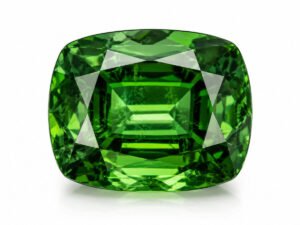
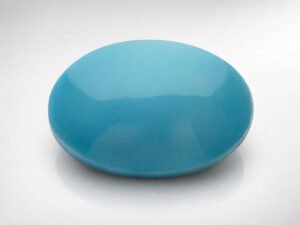
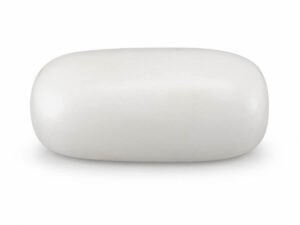
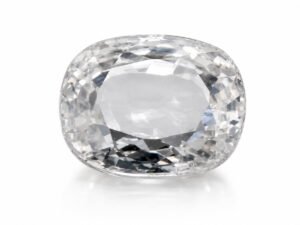
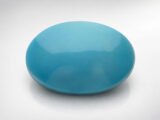
A Firoza stone (Turquoise) is one of the oldest gemstones worked by man, and one of the hardest to buy with confidence. Roughly 90% of the turquoise sold worldwide has been stabilized with resin, under 3% reaches the buyer untreated, and a great deal of what is sold at the entry level is dyed howlite, which contains no turquoise at all. That is why a turquoise stone price per carat means nothing until you know the treatment. This guide sets out Firoza prices by treatment grade, how untreated Firoza differs from stabilized, dyed and reconstituted stone, the ratti weight traditionally used for Guru, and the checks that tell you which one you are holding.

Firoza Quick Facts
| Chemical Composition | Hydrated Copper Aluminum Phosphate |
| Chemical Formula | CuAl₆(PO₄)₄(OH)₈·4H₂O |
| Hardness | 5 – 6 on Mohs Scale (soft, porous) |
| Specific Gravity | 2.60 – 2.90 |
| Hindi/Urdu Name | Firoza (फ़िरोज़ा) |
| Astrological Planet | Jupiter (Guru) — worn as the upratna (substitute) for Pukhraj; some traditions also link it to Ketu |
| Best Origins | Iran (Persian), USA (Sleeping Beauty), Tibet |
| Price Range (India) | From ₹320 per carat (approx. US$3.70); fine gem-grade material ₹5,000+ (US$57+) |
What is Firoza Stone (Turquoise)?
Firoza (also spelled Feroza or Phiroza) is the Persian and Urdu name for Turquoise — an opaque, sky-blue to blue-green hydrated copper aluminum phosphate mineral with the chemical formula CuAl₆(PO₄)₄(OH)₈·4H₂O. Crystallizing in the triclinic system, Firoza is one of the oldest gemstones known to mankind, worked as early as 5000 BCE. The English name “Turquoise” comes from the French “pierre turquoise” (“Turkish stone”), as historical trade routes carried the gemstone from Persian mines through Turkey to Europe.
Firoza’s classic sky-blue color is driven by the presence of copper ions. When iron replaces aluminum in the crystal lattice, the color shifts towards green. Distinct origins yield different matrix (host rock) and mineral profiles:
- Persian (Irani) Firoza: Sourced from the ancient mines of Nishapur (Iran). Famous for its intense, clean, matrix-free “robin’s egg” blue. This is the world’s most premium quality.
- American Firoza:
- Sleeping Beauty (Arizona): Celebrated for pure, matrix-free sky-blue color. The mine closed in 2012, making remaining stocks highly collectible.
- Kingman (Arizona): Yields diverse colors, often showing black webbing matrix.
- Morenci (Arizona): Highly prized for metallic iron pyrite inclusions that shine like silver.
- Bisbee (Arizona): Known for deep blue colors set in a smoky, chocolate-brown matrix.
- Tibetan Firoza: Typically greenish-blue to deep green due to high iron content, displaying bold spiderweb matrix lines composed of limonite (hydrated iron oxide).
Types of Turquoise by Origin
Origin Comparison
| Origin | Color | Matrix | Value |
|---|---|---|---|
| Persian/Irani | Intense “robin’s egg” blue | Often clear (no matrix) or fine spiderweb | Fine material is the world benchmark; ordinary Irani is modestly priced |
| American (Sleeping Beauty) | Pure sky blue | Usually clear, no matrix | Very high; the mine closed in 2012, so supply is finite |
| American (Various Mines) | Blue to blue-green | Distinctive matrix patterns (chocolate brown, pyrite) | High (collector value) |
| Tibetan | Blue-green to green | Bold spiderweb matrix (limonite) | Moderate-High |
| Chinese | Variable, often greenish | Variable heavy matrix | Moderate; the largest source by volume in the world today |
A word on Irani Firoza: Persian turquoise from the Nishapur mines has been the benchmark for fine color for over a thousand years, and its intense, matrix-free blue is genuinely rare. Two things about it are widely misunderstood. First, an origin is not a grade. Nishapur has produced everything from museum-quality material down to very ordinary stone, so a plain Irani cabochon can cost less per carat than a fine American one, and frequently does. Anyone who tells you Irani turquoise always carries a large premium is describing the top of the mine’s output, not the mine. Second, a gemological laboratory identifies the material and its treatment, but it does not certify a country of origin for turquoise. Judge an Irani claim by the stone in front of you: color, matrix and disclosed treatment can be verified, while geography, in almost every case, is the seller’s word.
Firoza Stone Price per Carat in 2026
Two separate things set the price of a Firoza stone: what the material is, and what has been done to it. Confusing the two is how buyers get caught. A stabilized stone with fine color can cost more than a plain untreated one, and an untreated Firoza is not automatically expensive — untreated only means nothing was added. What is genuinely rare, and priced accordingly, is a stone that is untreated, evenly colored, intensely blue and free of matrix all at once. A low price per carat is not by itself evidence that a stone is treated or fake.
Price by Material and Treatment
| What is being sold | Price (₹/carat) | What you are actually buying |
|---|---|---|
| Dyed howlite or magnesite | ₹50 – ₹250 (US$0.60 – $3) | Not turquoise at all. A white mineral soaked in blue dye |
| Reconstituted (block) | ₹150 – ₹500 (US$2 – $6) | Turquoise powder bonded in resin. Uniform color, no real depth |
| Stabilized turquoise | ₹300 – ₹1,500 (US$3.50 – $17) | Real turquoise, pores filled with resin. The market norm worldwide |
| Natural untreated, with matrix | ₹320 – ₹2,500 (US$3.70 – $29) | Real turquoise, nothing added. Sky blue to blue-green, matrix visible |
| Natural untreated, gem grade | ₹5,000 – ₹15,000+ (US$57 – $175+) | Even robin’s egg blue, little or no matrix. Fine Persian, Sleeping Beauty |
Typical Market Prices by Product Type
| Product | Size/Specs | Price Range (₹) |
|---|---|---|
| Loose Firoza Stone | 5-10 carat | ₹2,750 – ₹25,000 |
| Firoza Ring (Silver) | 5-8 carat stone | ₹3,000 – ₹15,000 |
| Firoza Pendant | 8-12 carat | ₹2,500 – ₹12,000 |
| Turquoise Bracelet | 8mm beads | ₹800 – ₹4,000 |
| Turquoise Mala (108 beads) | 6-8mm beads | ₹1,500 – ₹8,000 |
Indicative rates for July 2026, quoted in Indian rupees with US dollars converted at roughly ₹87 to US$1. Turquoise is sold per carat in India and more often per piece or per gram in the United States and Europe, so compare per-carat rates where you can. Every stone is priced individually on color, matrix and treatment.
What Affects Firoza Price?
- Origin: A famous source lifts price at the top of the market — fine Persian and Sleeping Beauty above all — but origin does not set price by itself. Grade within a single mine varies enormously
- Color: Pure, intense sky-blue (“robin’s egg”) is most valuable; greenish tones reduce value
- Matrix: Clear (no matrix) is rarest and most valuable; fine spiderweb adds value; heavy matrix reduces value
- Treatment: Under 3% of turquoise reaches the buyer untreated, so an untreated stone carries a premium over an identical stabilized one. Untreated by itself does not make a stone costly — color and matrix still set the rate
- Size: Larger stones of good quality are progressively rarer
Understanding Turquoise Treatments
Turquoise is porous and soft, so roughly 90% of what reaches the commercial market has been treated to harden it or hold its color, and under 3% is sold exactly as it came out of the ground. Treatment is not the problem — undisclosed treatment is. These are the five categories you will meet, and what separates them:
Treatment Types
| Treatment | Description | Acceptability | Detection Method |
|---|---|---|---|
| Natural (Untreated) | Nothing added. Cut and polished only, so color and structure are entirely the stone’s own. | Under 3% of the market; preferred for remedial use | Microscopy, plus FTIR showing no resin |
| Stabilized | Pores infused with clear acrylic or polymer resin under high pressure. | Industry standard, accepted | FTIR Spectroscopy (polymer peaks at ~1740 cm⁻¹) |
| Zachery Process | Proprietary chemical treatment using potassium to decrease porosity and improve color. | Accepted, must be disclosed | EDXRF Spectroscopy (elevated potassium, K₂O) |
| Enhanced/Dyed | Porous stone infused with colored dyes to mimic premium blue. | Colour is not the stone’s own; must be disclosed | Acetone swab, microscope (dye pooled in cracks) |
| Reconstituted | Turquoise dust and fragments bonded with plastic resin. | Imitation, avoid | FTIR / Magnification (plastic-like texture) |
Key Point: The line that matters most is not treated against untreated — it is turquoise against not-turquoise. Stabilized turquoise is real turquoise with resin in its pores: permanent, widely accepted, and held by most practitioners not to affect astrological use. Natural untreated turquoise is the same mineral with nothing added, and is the material traditionally preferred for planetary remedies. What to refuse: dyed stone, reconstituted block, and anything at all sold without its treatment stated in writing.
How to Identify Original Firoza Stone
Turquoise has more convincing imitations than almost any other gemstone. The two you will meet most often are dyed howlite, a calcium borosilicate, and dyed magnesite, a magnesium carbonate. Both are white minerals that take blue dye readily, and both carry dark veining that passes easily for natural matrix. Gilson synthetic turquoise is the third. Here is how to separate them:
Important Disclaimer: Simple physical tests can identify obvious dyed fakes, but they CANNOT confirm origin (e.g., Irani claims) or identify professional treatments like the Zachery process. Always obtain a certificate from a recognized gemological laboratory.
Test 1: Acetone Swab Test (For Dyed Imitations)
This simple chemical test identifies dye, whether it has been applied to howlite, magnesite or pale turquoise:
- Dip a cotton swab in pure acetone (nail polish remover).
- Gently rub the swab on an inconspicuous back area of the stone.
- If the cotton swab turns blue or green, the stone is dyed. Natural or resin-stabilized turquoise will not bleed color. Note that the reverse does not hold: a sealed or waxed dyed stone can pass this test, so a clean swab is encouraging but not proof.
Test 2: Microscopic Examination & Matrix Check
Examine the stone under a 10x magnification loupe or microscope:
- Natural Matrix: A genuine matrix (vein pattern) is irregular, jagged, organic, and embedded into the stone. It often contains natural metallic pyrite spots or brown limonite zones.
- Dyed Howlite/Magnesite: Look for dye concentration where color pools inside fractures and surface pits. You may also find unpenetrated white spots when inspecting deeper cavities.
- Gilson Synthetic: Displays a highly uniform microcrystalline structure, often completely clean, or showing artificial, “too-perfect” matrix lines that lack mineral diversity.
Test 3: Why the Scratch and Weight Tests Fail on Turquoise
The check that genuinely works at home needs no equipment. Look closely at a drill hole, a chip, or any unpolished edge: dyed howlite and magnesite are white or grey underneath, and the blue stops where the dye stopped soaking in, while genuine turquoise carries its color through the body of the stone. The two tests below are repeated everywhere and neither is reliable, which matters because a bad test will convince you that a genuine stone is fake:
- Do not scratch a turquoise. Firoza is Mohs 5.0 to 6.0 and a steel needle is about 5.5, so a needle will mark softer genuine turquoise exactly as it marks howlite at 3.5. The test cannot separate the two, and it leaves permanent damage on a stone you have paid for.
- Weight in the hand proves nothing. Turquoise has a specific gravity of 2.60 to 2.90; howlite is about 2.58. That difference is far too small to feel. Only moulded plastic is obviously light, and plastic gives itself away by mould seams and by warming quickly to the touch, not by weight.
Test 4: Lab Spectroscopy (The Only 100% Reliable Method)
Professional laboratories use advanced spectroscopy to verify authenticity:
- Raman / Infrared Spectroscopy: Confirms the chemical signature of hydrated copper aluminum phosphate, instantly exposing howlite (borosilicate) or magnesite (carbonate) fakes.
- EDXRF Spectroscopy: Detects elemental composition, revealing elevated potassium levels characteristic of the Zachery process.
Astrological Safeguard: For planetary remedies, tradition calls for natural, undyed turquoise. Check that the report identifies the stone as “Natural Turquoise” and states the treatment in plain words — unheated and untreated, stabilized, or dyed. A report that identifies the material but says nothing about treatment has answered only half the question.
Firoza in Vedic Astrology
In Vedic astrology Firoza is the recognised upratna, or substitute stone, for Pukhraj (Yellow Sapphire), and is worn for Jupiter (Guru) on an astrologer’s advice. Some traditions also give it to Ketu. It is generally chosen when a fine Pukhraj is out of reach, or when a lighter, larger stone is wanted for the same planet.
Who May Consider Wearing Firoza?
As per traditional Jyotish recommendations:
- Sagittarius (Dhanu) and Pisces (Meena) ascendants — Jupiter is the ruling planet
- Those seeking wisdom, success, and good fortune
- Individuals wanting protection from negative energies
- People in creative, communication, or travel-related professions
- Those wanting to pacify malefic Ketu effects
Traditional Astrological Symbolism of Firoza
In Vedic astrology, Firoza (Turquoise) represents the expansive energies of Jupiter (Guru). Traditional beliefs associate it with:
- Wisdom, learning and balanced judgement — the qualities traditionally given to Guru
- Protection on journeys. Turquoise was the traveller’s stone across Persia, Tibet and the American Southwest alike, often set on a horse’s bridle before it was ever set in a ring
- Clear speech and straight dealing with others
- Good fortune in Persian tradition, which is where the name Firoza — from “pirouzeh”, victory — reached India
- Worn by many as the stand-in for Pukhraj where a fine Yellow Sapphire is beyond reach
Traditional Wearing Guidelines
| Recommended Weight | 5 to 8 Ratti (approx. 4.6 to 7.3 carats), scaled to body weight |
| Finger | Index finger — the Jupiter finger — of the working hand |
| Metal | Silver (preferred) or Gold |
| Day to Wear | Thursday morning, Guru’s day, during Shukla Paksha (waxing moon) |
| Mantra | “Om Gram Grim Graum Sah Gurave Namah” (ॐ ग्रां ग्रीं ग्रौं सः गुरवे नमः) — 108 times |
| Cleansing | Cleanse with Gangajal or raw cow’s milk before wearing |
Determining the Correct Carat and Ratti Weight: For astrological benefits, the traditional rule of thumb is to choose a stone weight equivalent to 1 Ratti for every 10 kg of your body weight (e.g., a person weighing 60 kg is advised to wear a 6 Ratti stone). Since 1 Ratti equals 0.91 Carats, you can calculate the corresponding weight in Carats (1 Carat ≈ 1.09 Ratti). Whatever weight you settle on, make sure the natural Firoza stone comes with its treatment stated in writing — unheated and untreated, or stabilized. Tradition prefers untreated material for remedial wear.
Note: Astrological recommendations vary based on individual birth charts. Please consult a qualified Jyotish practitioner before wearing any gemstone for astrological purposes.
How to Evaluate Turquoise Quality
Turquoise is evaluated differently from transparent gemstones:
1. Color (50% of value)
- Best: Intense, pure “robin’s egg” or sky blue
- Good: Medium blue with slight green tint
- Average: Blue-green or green-blue
- Lower: Pale blue, heavily greenish, or grayish
2. Matrix (25% of value)
- Best: Clear (no matrix) — rarest
- High: Fine spiderweb matrix — adds character
- Average: Moderate matrix patterns
- Lower: Heavy, unattractive matrix dominating the stone
3. Treatment (15% of value)
- Best: Natural, untreated — under 3% of the market reaches the buyer this way
- Standard: Stabilized — the industry norm, permanent and accepted when disclosed
- Lower: Dyed — the color is not the stone’s own and can fade
- Avoid: Reconstituted block, and any stone offered with no treatment stated
4. Origin (10% of value)
- Persian (Irani): fine material sets the world benchmark, ordinary material is priced modestly. The name alone is not a grade
- American: Sleeping Beauty closed in 2012 and Bisbee in 1975, so both are finite and collected
- Tibetan: green-toned with bold spiderweb, valued more by collectors than by the trade
- Chinese: supplies most of the world’s turquoise today, at every grade from commercial to fine
How to Care for Firoza Jewelry
Because Firoza is a relatively soft (Mohs 5.0–6.0) and porous gemstone, it requires careful handling to prevent color shifts and structural damage:
Critical Warning: Why Firoza Changes Color: Firoza is a porous mineral that readily absorbs liquids. When worn against the skin, it absorbs sweat, body oils, cosmetics, and perfumes. Over time these oily and acidic compounds react with the copper and iron inside the stone, and the sky blue drifts permanently toward green. Resin stabilization seals the pores and resists this; an untreated stone relies on the care below instead. Worth knowing before you worry: a slow shift toward green over years is normal behaviour for natural turquoise and is not a sign that the stone is fake. Dyed howlite, by contrast, tends to fade patchily rather than deepen.
- Cleaning: Wipe gently with a soft dry cloth, or a barely damp lint-free one. Never use soap, detergent, jewellery dip or any acid — these soak into the pores and change the stone from the inside, and no polishing will bring it back.
- Never use an ultrasonic or steam cleaner: the vibration and heat will strip stabilizing resin or wax out of a treated stone and can fracture the porous structure of an untreated one. This is the single most common way a good Firoza is destroyed.
- Chemical Exposure: Always apply makeup, lotions, perfumes and hairspray first, and put your Firoza on last. Remove the stone before cooking, swimming, or doing heavy labor.
- Storage: Store Firoza separately in a soft cloth pouch, away from direct sunlight, to prevent it from getting scratched by harder gems like Sapphires or Rubies.
Buying Checklist: Original Firoza
Before purchasing, verify:
- ✓ Treatment stated in writing — unheated and untreated, stabilized, or dyed. Check this first, not last
- ✓ Lab report from a recognised laboratory identifying the material as natural Turquoise
- ✓ Matrix that looks natural and irregular, never uniform, painted or repeating
- ✓ Color that runs through any chip, drill hole or unpolished edge, not just across the surface
- ✓ A per-carat rate shown on the listing, so you can compare one stone against another
- ✓ A color you actually like. Sky blue, blue-green and green are preferences and price levels, not tests of whether a stone is real
- ✓ Return policy in writing
For comprehensive gemstone evaluation guidance, see our complete gemstone buying guide.
Why Buy Firoza from Ratna Gems?
Every Turquoise from Ratna Gems comes with:
- Lab Report With Every Stone: Identified as natural Turquoise by an ISO 9001:2015-certified laboratory. Never dyed howlite, never reconstituted block.
- Origin Named on Every Stone: Irani or American, stated on the listing beside the laboratory conclusion — never a vague “natural turquoise” with no source given.
- 7-Day Returns: Shop with confidence — full refund if not satisfied.
Frequently Asked Questions
What is the price of Firoza stone per carat?
Firoza is priced by treatment first and quality second. Dyed howlite sold as turquoise goes for roughly ₹50-250 per carat (about US$0.60-3). Stabilized turquoise, the market norm worldwide, runs ₹300-1,500 (US$3.50-17). Natural untreated stone with visible matrix runs ₹320-2,500 (US$3.70-29). Untreated gem-grade material, evenly robin’s egg blue with little or no matrix, starts near ₹5,000 (US$57) and climbs steeply from there. A low per-carat rate is not by itself evidence that a stone is treated or fake.
What is the difference between Irani and regular Turquoise?
Irani or Persian turquoise comes from the Nishapur mines in north-eastern Iran, worked for more than a thousand years and the historic benchmark for intense, matrix-free “robin’s egg” blue. But an origin is not a grade. Nishapur has produced material at every quality level, so an ordinary Irani cabochon can cost less per carat than a fine American stone. Treat the origin as a reputation, and judge the individual stone on color, matrix and disclosed treatment.
How to identify original Firoza from fake?
The most useful check needs no equipment. Look at a drill hole, a chip or any unpolished edge: dyed howlite and magnesite are white or grey underneath and the blue stops where the dye stopped soaking in, while genuine turquoise carries its color through the body of the stone. An acetone swab on an inconspicuous spot will lift dye, though a sealed stone can still pass. Do not scratch-test turquoise — at Mohs 5 to 6 a steel needle marks genuine stone as readily as it marks howlite, so the test proves nothing and permanently damages the gem. For certainty on treatment, use a laboratory report.
Is stabilized Turquoise okay for astrology?
Most practitioners accept stabilized turquoise, holding that resin in the pores changes neither the mineral nor its planetary association. Stabilization is permanent, and it is what makes a porous stone wearable — roughly 90% of the turquoise on the world market has been treated in some way. Tradition still prefers untreated stone for remedial wear where you can get it, and under 3% reaches the buyer that way. What is ruled out for remedial use is dyed and reconstituted material, where the color is not the stone’s own.
Which planet is Firoza associated with?
In Vedic astrology Firoza is the upratna, or accepted substitute stone, for Pukhraj (Yellow Sapphire), and is worn for Jupiter (Guru) — the planet of wisdom, learning and good fortune. Some traditions also give it to Ketu. It is usually chosen when a fine Yellow Sapphire is beyond reach, or when a larger stone is wanted for the same planet. Sagittarius (Dhanu) and Pisces (Meena) ascendants are the ones most often advised to wear it. Consult a qualified astrologer before wearing any gemstone for remedial purposes.
Which finger and metal are best for Firoza?
Firoza is traditionally set in silver, though gold is also used, and worn on the index finger — the Jupiter finger — of the working hand. It is put on for the first time on a Thursday morning, Guru’s day, during Shukla Paksha, the waxing phase of the moon. The ring is rinsed in Gangajal or raw cow’s milk before wearing.
How many Carats or Ratti of Firoza stone should I wear?
The traditional rule is 1 Ratti of Firoza for every 10 kg of body weight, so a person of 70 kg would wear about 7 Ratti, which is 6.4 carats, since 1 Ratti equals 0.91 carat. Treat this as a starting point rather than a fixed rule: an astrologer working from your birth chart may advise a different weight. Whatever the weight, make sure the stone is natural turquoise with its treatment stated in writing.
Can Turquoise be worn daily?
Turquoise is Mohs 5 to 6 and porous, which makes it one of the softer stones in regular jewellery use. It suits pendants and earrings better than rings. If you do wear a ring, take it off for housework, gardening and swimming, and put it on after cosmetics rather than before. Never place turquoise in an ultrasonic or steam cleaner. Be wary of any listing that gives turquoise a hardness of 7 — that is quartz’s figure, not turquoise’s, and it usually signals a copied specification table.
Why is my Turquoise changing color?
Turquoise is porous and absorbs skin oils, sweat, lotion and perfume. Over years these react with the copper and iron inside the stone and the blue drifts toward green. This is normal behaviour for natural turquoise and not a sign that the stone is fake — untreated material shows it most readily because its pores are open, while stabilized stone resists it. To slow it down, put your Firoza on last after cosmetics, keep it away from chemicals, and wipe it with a dry cloth rather than washing it.