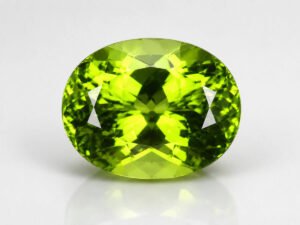
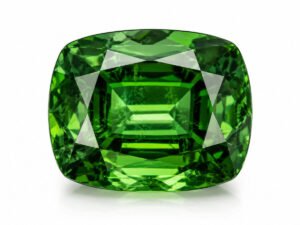
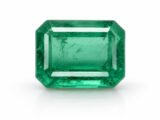
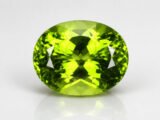
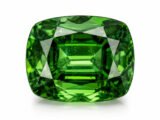
Looking for a vibrant green gemstone that won’t break your bank like Emerald (Panna)? Peridot might be your answer. Known as the “Evening Emerald” for its glow even in low light, Peridot is the only gemstone that occurs in just one color — green. According to Vedic astrology practitioners, it serves as an effective Upratna (substitute) for Emerald. This guide covers Peridot stone meaning, its unique properties, current prices in India, and how to buy authentic stones.
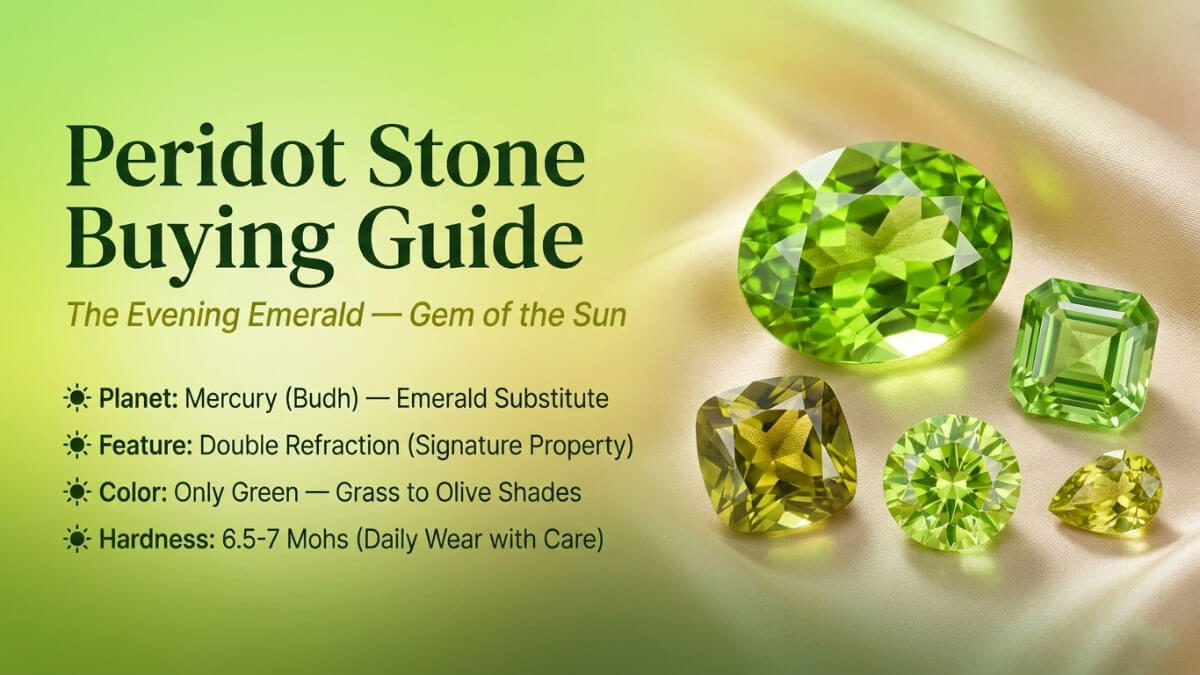
Peridot (Zabarjad) Quick Specifications
| Chemical Composition | Magnesium Iron Silicate [(Mg,Fe)₂SiO₄] (Forsterite end-member) |
| Mineral Species | Olivine Group (Orthorhombic crystal system) |
| Color Nature | Idiochromatic (Iron-rich green coloration) |
| Mohs Hardness | 6.5 – 7.0 (Moderate toughness) |
| Specific Gravity | 3.27 – 3.37 |
| Refractive Index | 1.654 – 1.690 (Double Refractive) |
| Birefringence | 0.036 (Strong, causes visible doubling of back facets) |
| Diagnostic Inclusions | Disc-shaped tension cracks around chromite crystals (“lily pads”) |
| Astrological Status | Mercury (Budh Dev) Upratna (Substitute for Emerald/Panna) |
Peridot Stone Meaning: What Does It Symbolize?
The meaning of Peridot has roots stretching back 3,500 years. Ancient Egyptians mined it on the Red Sea island of Zabargad and called it the “Gem of the Sun” — they believed it offered protection from evil spirits and nightmares.
The name “Peridot” comes from either Arabic faridat (meaning “gem”) or Greek peridona (meaning “giving plenty”). Both references point to its traditional association with abundance.
What Peridot Represents
- Abundance & Prosperity: Traditionally considered a stone that attracts wealth
- Emotional Healing: In crystal healing traditions, it’s associated with releasing jealousy and resentment
- Protection: Ancient cultures used it as a talisman against negative energies
- Renewal: Symbolizes new beginnings and personal growth
As the August birthstone, Peridot is also the traditional gift for 16th wedding anniversaries.
Did You Know? Peridot is one of only two gemstones formed deep in Earth’s mantle (not the crust) and brought up by volcanic activity. Some Peridot has even been found in meteorites!
Properties of Peridot: Physical, Optical & Extraterrestrial
Understanding the unique physical and optical properties of Peridot is essential to verify authenticity and appreciate why this ancient gemstone continues to captivate collectors and astrologers.
1. Double Refraction (Birefringence) — The Visual Signature
Peridot exhibits an exceptionally high birefringence (0.036). When light enters the crystal structure, it splits into two distinct rays that travel at different velocities. When you view a faceted Peridot under a 10x jeweler’s loupe (looking down through the table facet at the pavilion facets on the back), you will observe a distinct doubling of the facet junctions. The edges of the back facets appear doubled or blurry. Glass and other singly refractive simulants show only a single, sharp edge.
2. Idiochromatic Color Structure
Peridot is one of the few idiochromatic gemstones, meaning its color is caused by the essential iron element in its chemical formula (Mg,Fe)₂SiO₄, not by trace impurities. Consequently, Peridot only occurs in shades of green. The iron content determines the shade: a high iron percentage produces deep grass-green or olive-green colors, whereas lower iron results in yellowish lime-green. Minor traces of chromium or nickel can modify the color saturation, but you will never find blue, pink, or red Peridot.
3. Diagnostic Inclusions: The “Lily Pad” Effect
Natural terrestrial Peridots contain diagnostic, disc-shaped stress fractures called “lily pads” under magnification. These fractures are created by thermal expansion stress surrounding tiny, solid, black crystals of chromite or chromian spinel. If you spot these circular, lily-pad-like inclusions under a microscope, it confirms the gemstone is natural and of terrestrial volcanic origin.
4. Extraterrestrial Peridot: Pallasite Space Gems
Remarkably, Peridot also arrives on Earth from outer space. Pallasitic Peridot is extracted from rare stony-iron pallasite meteorites. When these meteorites are cut and polished, they reveal translucent olivine crystals embedded in a metallic nickel-iron matrix. Pallasitic peridot is chemically distinct from terrestrial peridot, showing a unique trace-element signature (extremely low lithium, vanadium, and distinct ratios of nickel, cobalt, and manganese). Due to their extreme rarity and interstellar origin, faceted pallasitic peridots are highly prized by collectors.
Peridot Color Grades & Valuation
| Color Grade | Visual Profile | Market Value Efficacy |
|---|---|---|
| Vivid Grass Green | Vibrant, rich green with no yellow or brown tones. Extremely rare in sizes above 3 carats. | Highest: Most valuable for fine jewelry and astrological remedies. |
| Olive Green | Deep, saturated green with subtle golden or olive undertones. Highly sparkling. | High: Highly sought after in standard calibrated cuts. |
| Lime Green | Bright yellowish-green, common in Arizona deposits. | Moderate: Good for fashion and budget jewelry. |
| Brownish-Green | Dull green with a heavy brown mask. Frequently Chinese material, which spans a wide quality range and should be judged stone by stone rather than by origin. | Lower: Mostly used for commercial bead strands. |
Peridot Stone Price in India (2026)
The price of an original Peridot stone in the Indian market ranges from ₹500 to over ₹20,000 per carat, depending on its quality, weight, and geographic origin. Wholesale processing hubs like Jaipur price loose Peridots per carat, while finished rings or pendants include metal costs. Here is the market index for 2026:
Peridot Price Index (Jaipur 2026)
| Quality Grade | Typical Characteristics | Jaipur Price Range (Per Carat) |
|---|---|---|
| Commercial Grade | Yellowish-green to brownish-green, some visible inclusions or cloudy appearance. | ₹500 – ₹1,500 |
| Good Grade | Bright lime-green, eye-clean under normal lighting, good cut. | ₹1,500 – ₹3,500 |
| Fine Grade (Kaghan Valley) | Vivid grass-green to deep olive-green, completely eye-clean, brilliant round/oval cut. | ₹3,500 – ₹8,000 |
| Exceptional Grade | Vibrant, rich neon green, clean under 10x magnification, typically above 5 carats. | ₹8,000 – ₹20,000+ |
| Pallasitic (Meteoritic) | Rare, faceted interstellar gems, showing nickel-iron trace markers, highly collected. | ₹40,000 – ₹1,00,000+ |
Price by Origin
| Origin | Price (₹/carat) | Characteristics |
|---|---|---|
| Pakistani (Kashmir) | ₹5,000 – ₹20,000+ | Rich grass green, large sizes — most valued |
| Burmese | ₹3,000 – ₹12,000 | Deep olive green, excellent clarity |
| Arizona (USA) | ₹2,000 – ₹8,000 | Bright lime green, usually smaller sizes |
| Chinese | ₹500 – ₹3,000 | Variable quality, often yellowish |
What Affects Peridot Price?
- Color: Pure grass green commands 3-5x more than yellowish or brownish stones
- Clarity: Eye-clean is expected; loupe-clean is premium
- Size: Price per carat jumps significantly above 5 carats
- Origin: Pakistani Peridot fetches the highest prices
Important: Genuine Peridot is typically NOT treated or enhanced. If someone offers “treated Peridot” at a discount, be suspicious — it may be glass or a different material entirely.
Peridot in Vedic Astrology & Wearing Rituals
In Vedic astrology (Jyotish), Peridot (often called *Zabarjad*) is the primary Upratna (substitute gemstone) for Emerald (Panna). Both are ruled by the youthful, intellectual planet Mercury (Budh Dev). Astrologers recommend Peridot to pacify or strengthen Mercury, boosting communication skills, logical reasoning, financial success, and business acumen. It is highly suited for Gemini (*Mithun*) and Virgo (*Kanya*) ascendants. To activate these astrological energies, follow these traditional rules:
Astrological Rules for Wearing Peridot
| Auspicious Ascendants | Highly recommended for Gemini (Mithun) and Virgo (Kanya) ascendants. It is also beneficial for Taurus, Libra, and Capricorn ascendants where Mercury acts as a functional benefic. |
| Correct Finger | The little finger (Kanishtha) of your dominant hand. Associated with Mercury. |
| Ideal Metal | Set in Sterling Silver or Gold. Gold is often preferred to warm up Mercury’s communications, but Silver is widely accepted. |
| Auspicious Day & Hour | Wednesday morning (after sunrise, preferably during the Budh Hora), during the Shukla Paksha (waxing phase of the moon). |
| Vedic Sizing standard | Wear approximately 1 Ratti for every 10 kg of body weight (e.g., a 70 kg person should wear a 7 Ratti stone). Using the formula 1 Pukka Ratti = 0.91 Carats, a 7 Ratti stone is roughly 6.37 Carats. Always demand certifications in Carats. |
| Prana Pratishta Ritual | Soak the ring or pendant in a copper bowl containing raw cow’s milk, honey, Gangajal, and Tulsi leaves for 30 minutes. Rinse in fresh water and pat dry. Recite the Budh Beej Mantra 108 times: “Om Bum Budhaya Namaha” or “Om Budhaya Namah”, then wear it immediately. |
Note: Astrological gemstone recommendations vary based on individual birth charts. Please consult a qualified Jyotish practitioner before wearing any gemstone for astrological purposes. If you’re unsure which gemstone suits you, get proper guidance first.
How to Identify Original Peridot
Before buying, learn to distinguish genuine Peridot from fakes:
The Double Refraction Test (Best Home Method)
- Hold the stone under good lighting
- Look through the table (top) at the back facets
- Rotate slowly and observe the facet edges
Genuine Peridot: Back facet edges appear doubled/blurry
Glass/Fake: Edges appear single and sharp
Other Verification Points
- Color consistency: Real Peridot is ONLY green — never blue, red, or pink
- Natural inclusions: Look for “lily pad” disc-shaped inclusions (characteristic of Peridot)
- Weight: Peridot feels heavier than glass of the same size
- No air bubbles: Round air bubbles indicate glass
For Valuable Purchases: Always request a certificate from a recognized gemological laboratory. Visual tests help, but lab certification is the only 100% reliable method.
Peridot is not a lesser emerald. The two are separate mineral species that happen to share a colour family — peridot is olivine, emerald is beryl — and they behave completely differently. Emerald is almost always oiled or resin-filled to improve the look of its fractures; peridot is almost never treated at all, so the colour and clarity you see is what the earth produced. Peridot also has such strong double refraction that you can see the back facets doubled through the table with a loupe, a diagnostic no emerald offers. In Jyotish, peridot is the recognised Uparatna for Emerald (Panna) and both are worn for Budh. There is a real argument for preferring peridot on its merits: it is one of the very few gemstones that reaches the buyer exactly as the earth made it, with no oil, no resin and no heat, and at ten carats it is still obtainable clean and well cut — a size at which fine emerald has effectively left the market. Peridot is not the compromise version of a green stone. It is a different stone with a different case.
Peridot vs. Emerald: Quick Comparison
Since Peridot serves as an Upratna for Emerald, here’s how they compare:
Key Differences
| Factor | Peridot | Emerald |
|---|---|---|
| Color Tone | Yellow-green to olive | Bluish-green to pure green |
| Hardness | 6.5 – 7 | 7.5 – 8 |
| Typical Clarity | Usually eye-clean | Usually included |
| Fine Quality Price | ₹3,500 – ₹8,000/ct | ₹1,200 – ₹50,000 and upward/ct |
| Treatment | Rarely treated | Oil/resin filling common |
| Astrological Status | Upratna (substitute) | Primary Mercury stone |
How to Care for Peridot Jewelry
Peridot has moderate hardness (6.5–7) and chemical sensitivities that require careful handling. Follow these rules to protect its polished surface and prevent damage:
- Chemical Acid Sensitivity: Peridot is highly reactive to sulfuric acid and hydrochloric acid. Never place it in jewelry “pickle” cleaning baths, which contain sulfuric compounds, as it will instantly etch and dull the stone. Furthermore, keep it away from mild organic acids like citric acid (lemon juice) or vinegar, which can damage its vitreous polish.
- Thermal Shock Warning: Peridot is sensitive to rapid temperature changes. Hot steam cleaning or boiling water can cause internal fractures or complete shattering.
- No Ultrasonic Cleaners: The high-frequency vibrations of ultrasonic machines can expand stress fractures surrounding its natural “lily pad” inclusions, cracking the gemstone. Clean only in lukewarm, soapy water using a very soft-bristled brush.
- Separate Storage: Store your Peridot jewelry separately in velvet pouches, away from harder gemstones like sapphires, rubies, or diamonds, which can easily scratch it.
How to Buy Original Peridot: Checklist
Before purchasing, ensure:
- ✓ Stone shows double refraction when examined
- ✓ Color is green only (no other colors exist in Peridot)
- ✓ Price matches the grade — strong neon-green colour, clean facets and larger sizes command the top of the range, and a correctly priced fine stone should sit there
- ✓ Seller provides lab certification from recognized laboratory
- ✓ Return policy is available
- ✓ Origin is disclosed
For comprehensive guidance on evaluating any gemstone, see our complete gemstone buying guide.
Why Buy Peridot from Ratna Gems?
Our peridot is high-grade natural material — untreated, individually cut, and supplied with a report from an ISO 9001:2015-certified laboratory. Stones run to around ten carats, a size at which peridot has to be both clean and strongly coloured to be worth faceting at all, because weak colour and inclusions show far more in a large stone than a small one. The rate is set for that grade and held consistently across the range, so when you compare two of our peridots you are comparing the stones, not the pricing.
At Ratna Gems, every Peridot comes with:
- Lab Certification: Every stone authenticated by recognized gemological laboratory with Lifetime Authenticity Guarantee.
- Origin Transparency: We disclose where every Peridot is sourced with honest quality grading.
- 7-Day Returns: Shop with confidence — full refund if not satisfied.
Frequently Asked Questions
What is the meaning of a Peridot stone?
Peridot meaning is rooted in abundance, protection, and renewal. Ancient Egyptians called it the “Gem of the Sun” and mined it on Zabargad Island to ward off negative spirits. It is the August birthstone, symbolizing growth and emotional healing.
What are the physical and optical properties of Peridot?
Key properties include: a chemical formula of (Mg,Fe)₂SiO₄ (olivine group), orthorhombic crystal system, Mohs hardness of 6.5–7, specific gravity of 3.27–3.37, and a refractive index of 1.654–1.690. It is idiochromatic (only green) and displays strong birefringence (0.036), causing visible doubling of back facet edges.
What is the price of Peridot stone in India?
The price of Peridot in India ranges from ₹500–₹1,500 per carat for commercial qualities, up to ₹3,500–₹8,000 per carat for fine Pakistani (Kaghan Valley) stones displaying a rich grass-green hue. Premium clean gems over 5 carats can reach ₹20,000+ per carat.
What are the astrological benefits of Peridot as an Upratna?
Peridot serves as the primary astrological substitute (Upratna) for Emerald (Panna). Ruled by Mercury (Budh Dev), it enhances intellectual capability, logical reasoning, speech clarity, and success in trade. It is highly recommended for Gemini and Virgo ascendants.
How can I test if a Peridot stone is original?
Use the Double Refraction test: look down through the table facet at the back pavilion facets; if you see doubled facet edges, it is genuine. Under a loupe, look for diagnostic “lily pad” inclusions around tiny chromite crystals. Avoid stones containing round gas bubbles (glass).
Why does acid damage Peridot jewelry?
Peridot is chemically sensitive to mineral and organic acids. Sulfuric acid (found in jewelry cleaning pickle baths) and hydrochloric/citric acids will chemically attack the magnesium-iron silicate structure, permanently etching and dulling its polished surface.
How do I calculate the correct Peridot weight for my body weight?
The standard astrological rule is to wear 1 Ratti for every 10 kg of body weight. For instance, a 70 kg person should wear a 7 Ratti Peridot, which translates to approximately 6.37 Carats (using the formula: 1 Pukka Ratti = 0.91 Carats).