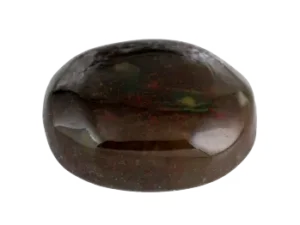
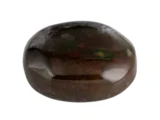
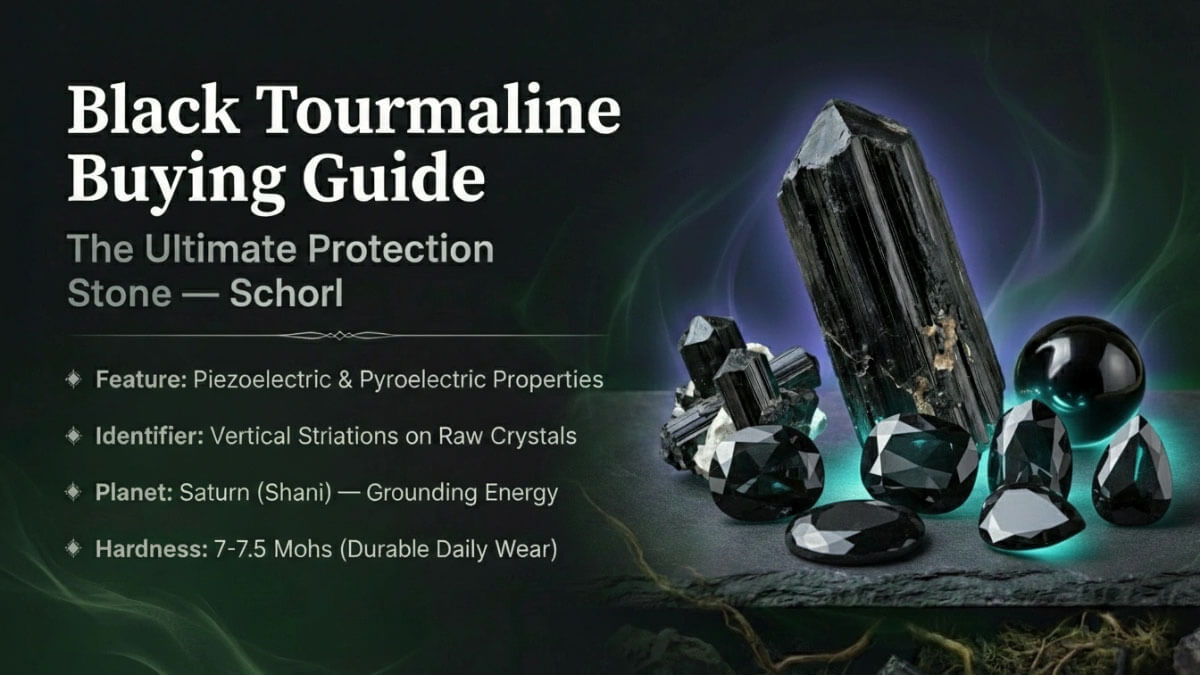
Black Tourmaline, known mineralogically as Schorl, stands as one of the most affordable yet scientifically fascinating protection stones available to Indian buyers. Priced between ₹150-550 per carat for cut stones and as low as ₹10000-30000 per kilogram at wholesale in Jaipur, this iron-rich crystal combines genuine scientific properties—documented piezoelectric and pyroelectric effects—with millennia of cultural significance across civilizations from ancient Egypt to Vedic India. This comprehensive guide covers everything from chemical composition to Vastu placement, from authentication methods to honest EMF claims assessment, ensuring readers have complete knowledge before purchasing.
Scientific foundation: what makes Black Tourmaline unique
Black Tourmaline belongs to the tourmaline mineral group with the chemical formula NaFe²⁺₃Al₆(BO₃)₃Si₆O₁₈(OH)₄. The deep black color comes from high concentrations of divalent iron (Fe²⁺) at the Y-site positions within its crystal structure. When Fe²⁺-Fe³⁺ interactions occur at high iron concentrations, absorption bands intensify by approximately 200 times compared to isolated iron atoms—making Schorl completely opaque and jet black, never transparent.
The mineral crystallizes in the trigonal crystal system with a distinctive non-centrosymmetric structure (space group R3m). This asymmetry creates tourmaline’s most remarkable properties: permanent electric polarity. No other common mineral forms three-sided crystal prisms with the characteristic vertical striations that make tourmaline instantly recognizable to trained eyes.
Physical properties at a glance
| Property | Value | Significance |
| Mohs Hardness | 7-7.5 | Durable enough for daily jewelry wear |
| Specific Gravity | 3.02-3.26 | Noticeably heavier than imitations |
| Refractive Index | 1.624-1.644 | Useful for professional identification |
| Crystal System | Trigonal | Creates signature striations |
| Luster | Vitreous to submetallic | Glass-like shine indicates authenticity |
| Transparency | Always opaque | Never transparent or translucent |
Black Tourmaline forms in granite pegmatites during the final stages of magma crystallization, typically at temperatures between 150°C and 900°C. It’s commonly found alongside quartz, feldspar, mica, and occasionally beryl. Approximately 95% of all tourmaline in nature is Schorl—making it abundant and affordable compared to gem-quality colored varieties.
Pyroelectricity and piezoelectricity: the real science
Tourmaline was the first natural pyroelectric material ever discovered, with observations dating back over 2,300 years to ancient Greece. Philosopher Theophrastus documented how heated tourmaline attracted straw and wood bits. Dutch traders in the 18th century called it “Aschentrekker” (ash puller) because heated tourmaline crystals would attract pipe ashes—a phenomenon caused by electrical charges developing when the crystal’s temperature changes.
The piezoelectric effect—generating electrical charge under mechanical pressure—was also first documented in tourmaline during the 1880s by Pierre and Jacques Curie. Modern measurements show piezoelectric coefficients of 9.5 pC/N for iron-based tourmaline. This property found practical application in World War II-era pressure gauges for detecting blast waves and explosion pressures, documented in U.S. Department of Energy records.
These electrical properties are scientifically verified and arise from tourmaline’s asymmetric crystal structure. However, as explored later in this guide, the leap from “generates small electrical charges under specific conditions” to “protects against electromagnetic radiation” remains unsupported by evidence.
Origins, quality, and what drives pricing
Major global sources
Brazil dominates global production, accounting for approximately 90% of gem-quality tourmaline. The Minas Gerais region, particularly the Cruzeiro mine, produces deep black Schorl with excellent crystalline structure. Brazilian material is considered the benchmark for quality—consistent color, large well-formed crystals, and reliable supply.
African sources have grown increasingly important. Madagascar produces specimens valued for distinctive saturation, while Namibia’s Tsumeb region yields exceptional clarity. Mozambique has emerged as a major supplier, particularly from Nampula Province, producing less-included material in larger sizes. Tanzania, Nigeria, and Kenya contribute significant volumes to world supply.
Afghanistan’s Nuristan region produces superb crystal specimens from the Paprok Valley, though political instability affects consistent supply. Material typically routes through Peshawar, Pakistan—a major South Asian gem trading center with connections to global markets.
Does India have Black Tourmaline deposits?
India does have Black Tourmaline deposits, though India is not a major commercial producer. Confirmed locations include Ajmer and Bhilwara districts in Rajasthan (associated with Aravalli Mountain pegmatites), Malkangiri area in Odisha, and Puttirol village in Andhra Pradesh. Scientific studies document tourmaline in Karnataka’s Chitradurga greenstone belt. However, these deposits are primarily artisanal-scale, insufficient for commercial export, and more significant for geological study than gemstone trade. Most Black Tourmaline in Indian markets is imported—primarily from Brazil and African nations through Mumbai, with processing centered in Jaipur.
Current market pricing in Indian Rupees (December 2025)
Black Tourmaline offers exceptional value compared to most semi-precious gemstones. The Jaipur wholesale market provides the best prices in India, with significant markup at retail.
Cut/Polished stones per carat:
- Commercial/Low Grade: ₹150-250
- Medium Quality: ₹250-400
- Premium/High Grade: ₹400-550
- Collector specimens: ₹500+
Raw/Rough stones:
- Jaipur wholesale: ₹100-300 per kilogram
- Quality rough (African origin): ₹1,950/kg wholesale
- Online retail (Flipkart, Amazon): ₹1,600-1,800/kg
Popular product pricing:
- Tumbled stones (3 pieces): ₹399-499
- Pyramids (2 inch): ₹349-399
- Bracelets (8mm beads): ₹550-899
- Certified premium bracelets: ₹1,349
- Pendants: ₹399-499
The retail markup typically runs 5-10x wholesale for raw stones and 2-4x for finished products. For budget-conscious buyers, ₹500-1,000 provides access to quality bracelets, medium pyramids, or approximately 1kg of raw material at wholesale.
Factors affecting price
Unlike Paraíba or Rubellite tourmalines, Black Tourmaline carries no significant origin premium—Schorl is abundant worldwide. Price primarily reflects form (faceted > cabochon > tumbled > raw), size (prices increase significantly above 5 carats), surface quality, and certification status. Lab-certified stones command 10-30% premiums over uncertified material.
How to identify authentic Black Tourmaline
The five-step home authentication test
Step 1 – Weight test: Black Tourmaline should feel noticeably heavy for its size. Specific gravity of 3.02-3.26 means it’s significantly denser than glass (2.4-2.8), plastic, or obsidian (2.35-2.60).
Step 2 – Striation check: Raw and cabochon specimens should display parallel vertical grooves (striations) running along the crystal length. These characteristic lines form during crystal growth and are absent in glass or plastic imitations.
Step 3 – Scratch test: With Mohs hardness of 7-7.5, real tourmaline cannot be scratched by a steel nail or knife (hardness 5.5). It will, however, scratch glass.
Step 4 – Static electricity test: Heat the stone gently near (not in) a candle flame for 30 seconds, allow to cool for 1-2 minutes, then hold near small paper pieces or dust. Authentic tourmaline attracts particles due to pyroelectric charge generation. Glass and plastic lack this property.
Step 5 – Light examination: Under bright light, real Black Tourmaline often reveals subtle brownish or dark red undertones—evidence of iron content. Completely uniform jet-black without any color variation may indicate synthetic material.
Professional verification
Gemological laboratories use refractive index measurement (1.616-1.698), specific gravity testing, and spectroscopic analysis (FTIR, Raman) for definitive identification. In India, respected certification options include IGI-GTL (Indian Gemmological Institute, Delhi), GII (Gemmological Institute of India, Mumbai), and SGL Labs with 158+ locations nationwide. For high-value specimens, GIA certification provides international recognition.
Distinguishing from similar black stones
Black Tourmaline vs Black Onyx: Onyx lacks striations (may show banding instead), feels lighter (SG 2.55-2.7), displays waxy rather than vitreous luster, and shows no pyroelectric effect. Much commercial “black onyx” is actually dyed agate.
Black Tourmaline vs Black Obsidian: Obsidian is volcanic glass—significantly softer (Mohs 5-5.5), lighter weight, and shows characteristic conchoidal fracture with curved, shell-like surfaces. Under magnification, thin obsidian edges may show translucency; tourmaline never does.
Black Tourmaline vs Black Spinel: Spinel is harder (Mohs 8), heavier (SG 3.58-3.61), and displays higher brilliance when faceted. Under directional sunlight, black spinel may reveal subtle blue or purple undertones. Spinel commands higher prices due to greater rarity.
Black Tourmaline vs Shungite: Shungite comes exclusively from Russia’s Karelia region, is much softer (Mohs 3.5-4), non-crystalline, and composed of 98% carbon. It lacks tourmaline’s striations and crystal structure.
EMF protection claims: separating science from marketing
This section provides an honest assessment that Indian buyers deserve before purchasing Black Tourmaline for EMF protection purposes.
What science actually confirms
Tourmaline’s pyroelectric and piezoelectric properties are real and well-documented. When heated or cooled, or when subjected to mechanical pressure, tourmaline crystals generate measurable electrical charges. These properties enabled legitimate scientific applications—tourmaline pressure gauges detected blast waves during World War II, documented in U.S. Department of Energy records.
Tourmaline can generate negative ions, but with critical limitations: it requires thermal cycling or mechanical stimulation to activate. A passive crystal sitting at room temperature produces minimal ion emission. Japanese research measured tourmaline’s constant weak charge at approximately 0.06mA—far below therapeutically significant levels.
What science does not support
EMF protection claims have been directly tested and debunked. Researchers at Sweden’s Karolinska Institute and Royal Institute of Technology tested numerous crystal-based “EMF protection” products: “We tested a huge number of stickers you would put on your phone of crystals… No one ever proved to do what they claimed to do. They just don’t work.”
The physics make the claims implausible: a small crystal cannot absorb radiation that doesn’t strike it directly. To actually block electromagnetic fields requires Faraday cage principles—conductive materials fully enclosing the radiation source. The tiny charges tourmaline produces are insufficient to affect room-scale electromagnetic fields. “EMF harmonization” is not a scientifically meaningful concept.
A balanced perspective
Black Tourmaline’s genuine electrical properties are fascinating from a physics standpoint and contributed to its reputation across cultures. If the stone provides psychological comfort or you appreciate its mineralogical properties, there’s no harm in ownership. However, it should not replace evidence-based EMF reduction strategies such as maintaining distance from devices or limiting screen time. Marketing claims about radiation protection remain unsupported by scientific evidence.
Vastu Shastra and Vedic astrology applications
The following represents traditional beliefs and cultural practices. This information is shared for educational purposes about Indian cultural traditions—not as claims of fact or medical advice.
Vastu placement guidelines
According to Vastu practitioners, Black Tourmaline is considered one of the most powerful protective crystals for homes. Traditional placement recommendations include:
Primary placements: The Southwest corner is most frequently recommended for grounding and relationship stability. Placing near the main entrance (particularly on the left side as you enter) is believed to act as an “energetic guard” blocking negativity. The four corners method—one piece in each corner of a room or home—is popular for comprehensive coverage.
Near electronics: Practitioners recommend placing Black Tourmaline near laptops, routers, and televisions based on the belief that it absorbs harmful EMF radiation. Note that this belief is traditional rather than scientifically verified.
Form preferences: Raw/natural stones are preferred for Vastu purposes as they are believed to retain “natural earth energy,” though polished and tumbled stones are also used. Black Tourmaline pyramids hold special significance due to sacred geometry beliefs about energy amplification.
Vedic astrology connections
In Vedic astrology traditions, Black Tourmaline is associated with Planet Saturn (Shani). This makes it relevant for those experiencing Shani Sade Sati, Shani Dasha periods, or challenging Saturn placements in their birth charts.
Important distinction: Black Tourmaline is not a traditional substitute for Blue Sapphire (Neelam) in classical Jyotish texts. Classical Neelam substitutes (Upratnas) include Iolite, Amethyst, Blue Tourmaline (Indicolite), and Lapis Lazuli. However, modern practitioners recommend Black Tourmaline as a gentler Saturn support stone—safer than Blue Sapphire without the intensive trial periods traditionally required for Neelam.
Traditional wearing guidance: The middle finger (Saturn’s finger) is recommended if wearing as a ring. Saturday is considered auspicious for beginning wear. Bracelets are popular and typically worn on the right hand for protection. According to practitioners, Black Tourmaline is considered safe for all zodiac signs as it’s primarily protective rather than activating specific planetary energies.
Traditional activation and cleansing
Practitioners recommend cleansing before first use and monthly thereafter. Moonlight cleansing (placing under full moon overnight) is most commonly recommended. Alternative methods include placing on Selenite slabs, sage/incense smoke (passing through dhoop for 30 seconds to several minutes), or sprinkling with Ganga Jal. Sunlight exposure should be limited to 1-2 hours to preserve appearance.
Historical significance and cultural traditions
Discovery and naming
The name “tourmaline” derives from the Sinhalese word “tōramalli,” meaning “stone of mixed colors”—reflecting tourmaline’s remarkable color variety. “Schorl” (the mineralogical name for black tourmaline) traces to the German village of Zschorlau in Saxony, with documentation predating 1400 CE. The first detailed description was written by Johannes Mathesius in 1562, documenting occurrences in Saxony’s tin mines.
Dutch East India Company traders introduced tourmaline to Europe in the late 1600s, calling it the “Ceylonese Magnet” after observing its ash-attracting properties. Their term “Aschentrekker” (ash puller) described how heated tourmaline would clean their Meerschaum pipes—an early observation of pyroelectricity.
The oldest known carved tourmaline
The Ashmolean Museum in Oxford holds a 2.4cm carved tourmaline depicting Alexander the Great in profile, confirmed by Gem-A in 2019 as the oldest known carved tourmaline specimen. Dating to the 2nd-3rd century BCE, this intaglio demonstrates tourmaline was valued in Mediterranean and Indian cultures for over 2,300 years.
Protection beliefs across civilizations
Black tourmaline has been associated with protection across nearly every culture that encountered it. Ancient Egyptians wore it as amulets against evil spirits and curses, believing it passed through a rainbow during its journey from Earth’s center. Roman soldiers wore black tourmaline talismans, and the stone was used for inducing tranquil sleep. African warriors adorned their shields with black tourmaline, believing it deflected arrows and spears. Native American shamans carried it for protection during vision quests and spirit world communication.
The Empress who changed an industry
Empress Dowager Cixi (1835-1908), arguably the most powerful woman in Chinese history, developed a legendary obsession with pink tourmaline that triggered a mining boom in California’s San Diego County. Her purchases made the Himalaya Mine and Tourmaline Queen Mine major global suppliers. When her tomb was looted in 1928, soldiers discovered tourmaline sculptures among the treasures—including carved tourmaline pillows and elaborate pendants.
Care, jewelry options, and practical buying advice
Cleaning and storage
The GIA-recommended cleaning method is simple: warm soapy water with mild dish soap, soaking for 5-15 minutes, gentle brushing with a soft-bristled toothbrush, thorough rinsing, and drying with a microfiber cloth. Avoid ultrasonic and steam cleaners—vibrations can cause fracturing due to internal inclusions, and high heat causes thermal shock.
Black Tourmaline is heat-sensitive; sudden temperature changes can cause cracking. Store separately from harder stones (diamonds, topaz, corundum) in fabric-lined compartments or individual soft pouches.
Water safety: Brief rinsing is safe, but avoid prolonged submersion. Salt water is corrosive and should be avoided entirely—salt particles can enter microscopic fractures and expand them over time. Remove Black Tourmaline jewelry before swimming in chlorinated pools or ocean water. The iron content can rust with extended water exposure.
Best jewelry applications
With Mohs hardness of 7-7.5, Black Tourmaline is durable enough for daily wear with reasonable care. Pendants and earrings offer excellent options—minimal exposure to impact. Bracelets work well but should be removed during activities with potential for bumps. Rings are suitable with protective bezel settings; prong settings expose the stone to greater damage risk.
Popular metal pairings include sterling silver (affordable, doesn’t interfere with traditional energy beliefs), gold (traditional, durable), and copper (popular in metaphysical circles). For jewelry, cabochon cuts highlight natural luster, while raw/rough settings maximize energy work appeal according to practitioners.
Smart buying decisions
Buy from established sources with documented return policies. In India, the Jaipur gem markets (Johari Bazaar, Sitapura SEZ) offer wholesale prices significantly below online retail. When buying online, request detailed photos showing natural striations; be wary of perfectly uniform stones or suspiciously low prices.
Questions to ask sellers: What is the stone’s origin? Is it natural and untreated? Can certification be provided? What is the return policy if authenticity is questioned?
Budget recommendations: ₹200-500 covers raw specimens, small tumbles, or basic pyramids. ₹500-1,000 provides access to quality bracelets and medium pyramids. ₹1,000-2,000 includes certified bracelets and premium shapes. Above ₹2,000 targets collector specimens and custom jewelry.
Frequently asked questions
Is Black Tourmaline safe for everyone to wear?
According to crystal healing traditions, Black Tourmaline is considered safe for all zodiac signs and is not believed to have the intense effects associated with Blue Sapphire. However, these are traditional beliefs rather than verified facts.
How do I know if my Black Tourmaline is real?
Authentic specimens feel heavy for their size, display vertical striations on raw pieces, cannot be scratched by steel, and attract small particles when heated then cooled. Completely uniform appearance without variations may indicate synthetic material.
Can Black Tourmaline go in water?
Brief rinsing is safe, but avoid prolonged soaking. Never use salt water—it can damage the stone over time. Remove before swimming or bathing.
Where should I place Black Tourmaline in my home according to Vastu?
Traditional recommendations include the Southwest corner for stability, near the main entrance for protection, and in all four corners for comprehensive coverage. Near electronics is popular based on EMF protection beliefs, though these claims lack scientific support.
Does Black Tourmaline really protect against EMF?
Tourmaline’s pyroelectric and piezoelectric properties are scientifically documented, but claims about EMF protection have been tested and not supported by evidence. The stone cannot absorb radiation that doesn’t directly strike it, and the electrical charges it produces are too small to affect room-scale electromagnetic fields.
What’s the difference between Black Tourmaline and Black Onyx?
Black Tourmaline is heavier, displays vertical striations, has vitreous luster, and exhibits pyroelectric properties. Onyx is lighter, may show white banding, has waxy luster, and lacks electrical properties. Much commercial “black onyx” is dyed agate.
How often should I cleanse my Black Tourmaline?
According to practitioners, monthly cleansing is recommended—preferably under full moonlight. More frequent cleansing may be warranted after exposure to negative environments or intense situations.
Is Black Tourmaline a substitute for Blue Sapphire in Vedic astrology?
It is not a classical substitute (Upratna) in traditional Jyotish texts. However, modern practitioners sometimes recommend it as a gentler Saturn support stone for those who cannot afford or tolerate Blue Sapphire’s intensity.
Conclusion: an exceptional value with genuine fascination
Black Tourmaline represents remarkable value in the gemstone world—a scientifically fascinating mineral with documented electrical properties, 2,300+ years of documented cultural significance, and accessible pricing starting around ₹150 per carat. Its pyroelectric and piezoelectric effects are real physics, contributing to legitimate historical applications from ash-attracting curiosities to World War II pressure sensors.
For Indian buyers, the stone offers accessible entry into crystal collecting, Vastu practice, or spiritual work without the premium pricing of many semi-precious gemstones. The key is informed purchasing: understanding what science actually supports, recognizing traditional beliefs as cultural practices rather than verified facts, and applying simple authentication tests before buying.
Whether valued for its genuine mineralogical properties, appreciated for its aesthetic appeal, or used in traditional practices, Black Tourmaline rewards those who take time to understand it properly. Armed with this comprehensive knowledge—from chemical composition to pricing, from authentication to cultural context—Indian buyers can make confident, informed decisions about this remarkable stone.