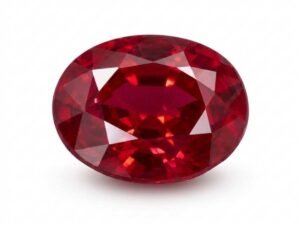
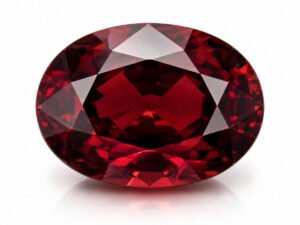
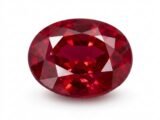
Ruby, the undisputed king of gemstones, known in India as Manik, is a symbol of power, passion, and sovereignty. Its fiery crimson hue has captivated royalty and collectors for millennia. As the primary gemstone for the Sun (Surya) in Vedic astrology, Manik is worn to command authority, boost confidence, and foster leadership. Buying a genuine, high-quality Ruby is a significant investment. This expert guide provides in-depth geological and astrological facts on how to evaluate its legendary color, understand different origins, identify treatments, and buy an authentic Ruby stone with complete confidence.
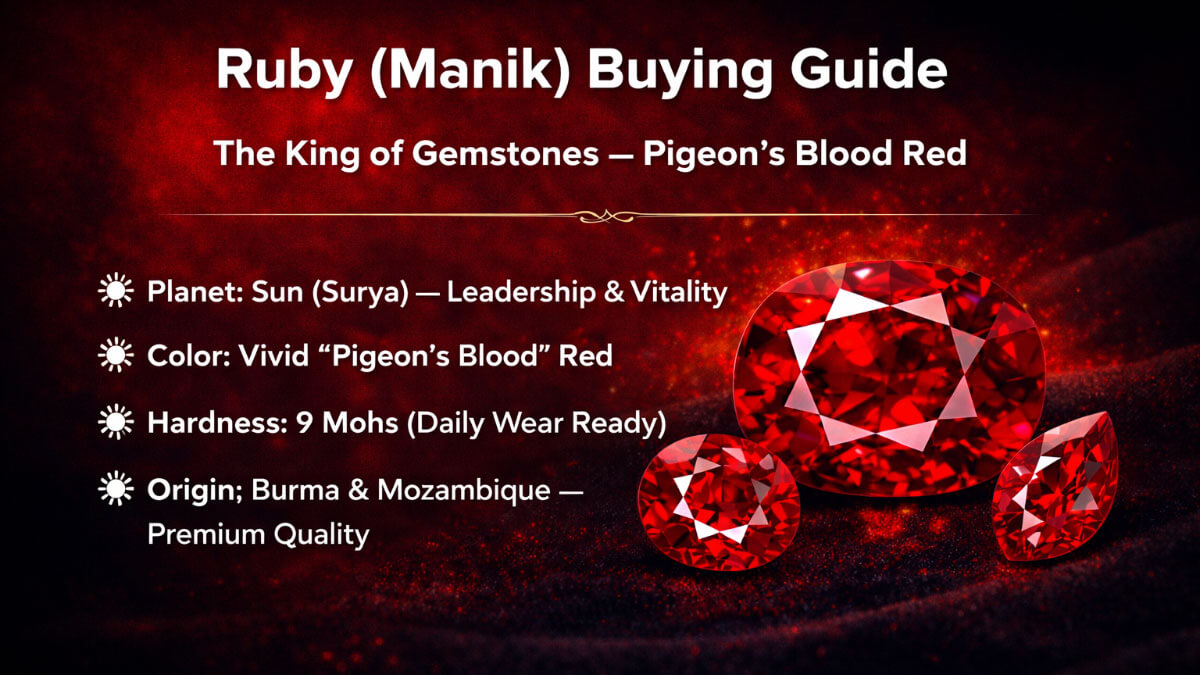
Ruby (Manik) Chemical & Physical Specifications
| Gemstone Family | Corundum |
| Chemical Composition | Aluminum Oxide (Al₂O₃) with chromium (Cr³⁺) traces acting as the red chromophore |
| Ruling Planet | Sun (Surya) |
| Mohs Hardness | 9 (Extremely durable; ideal for daily wear rings and pendants) |
| Specific Gravity | 3.97 – 4.05 |
| Refractive Index | 1.762 – 1.770 |
The Astrological Significance of Manik and How to Wear It
In Vedic astrology, Ruby is the primary gemstone for the Sun (Surya), representing leadership, vitality, the soul, and executive authority. While highly beneficial, chart alignment is crucial:
Astrological Rules for Wearing a Ruby (Manik)
| Who Should Wear It? | Highly recommended for Leo (Simha) ascendants (ruling sign), Aries (Mesha) where Sun is exalted, and Sagittarius (Dhanu). It is generally avoided by Taurus, Libra (where Sun is debilitated at 10°), Capricorn, and Aquarius ascendants unless specified under strict yogic cancellations. |
| Recommended Carat Weight | Generally 1/12th of the wearer’s body weight in kg (e.g., 6 carats for a 72kg individual), though specific planetary strength determines the exact requirement. |
| Which Finger? | The ring finger (Anamika) of the working hand. |
| Best Metal? | Gold or pure copper (matches the solar thermal energy). |
| Activation Ritual | Wear on Sunday morning during Shukla Paksha. Dip in Gangajal and raw cow’s milk, then chant the Surya Mantra: “Om Suryaya Namah” (ॐ सूर्याय नमः) 108 times. |
How to Buy an Original Ruby Stone: A Step-by-Step Guide
Step 1: Prioritize Color – The King of Factors
Color is the single most important factor in a Ruby’s valuation. The standard benchmark is a pure, highly saturated crimson red to a slightly purplish-red. High-quality rubies contain high concentrations of chromium (Cr³⁺) and low iron. This creates a brilliant red body color along with strong red fluorescence under UV light and daylight, effectively causing the stone to appear as if it is glowing from within.
Understanding “Pigeon’s Blood” Red: This legendary term refers to the most prized ruby color. It describes a pure, vivid red with a faint tint of purple or blue and a powerful red fluorescence. While historically associated with marble-hosted rubies from Mogok, Burma, this color grade is now also awarded by labs to exceptional stones from Mozambique.
Step 2: Understand Ruby Origins & Geological Environments
The geological environment in which a ruby forms dictates its trace chemistry, inclusion profiles, and ultimate value:
Comparison of Major Ruby Origins
| Origin | Typical Color & Geology | Inclusions & UV Fluorescence | Market Value & Rarity |
|---|---|---|---|
| Burmese (Mogok, Myanmar) | Vivid “Pigeon’s Blood” Red. Marble-hosted (low iron). | Fine intersecting rutile “silk” at 60°/120° angles creating velvety luster; twin-cleaved calcite/dolomite. Strong red fluorescence. | Highest premium. Supply is extremely scarce due to political bans and mining depletion. |
| Mozambique (Montepuez) | Brilliant crimson red to deep purplish-red. Amphibolite-hosted (moderate iron). | Fewer microscopic inclusions, offering exceptional clarity; low-to-moderate red fluorescence. | Very High. The leading modern source for high-quality, eye-clean jewelry stones. |
| Thai (Bangkok/Pailin) | Darker, brownish or purplish red (“Siam red”). Basalt-hosted (high iron). | High iron content acts as a fluorescence quencher, making the stone look dark and inert under UV. | Moderate. Often heat-treated to improve brightness. |
| African (Madagascar/Tanzania) | Varies from bright pinkish-red to deep dark red. | Highly variable clarity; often contains distinct mineral crystals and healing fissures. | Variable. Offers great budget alternatives. |
Step 3: Assess the Clarity
Due to the chaotic environments in which corundum forms, completely clean natural rubies are practically non-existent. A high-quality ruby should be “eye-clean” (inclusions not visible to the naked eye). The presence of microscopic rutile needles (silk) intersecting at 60° and 120° is highly valued, as it scatters light to create a velvety soft glow and proves natural origin. Be wary of perfectly clean rubies, which are often synthetic.
Step 4: Examine the Cut and Brilliance
Rubies are typically cut into oval or cushion shapes to preserve maximum carat weight from raw hexagonal crystals. A master cutter will orient the stone to showcase its best red color while minimizing the visibility of inclusions, avoiding a “window” (leaking light) in the center of the gemstone.
Step 5: Understand Indian Pricing Units & 2026 Prices
The weight of a ruby is measured in carats or traditional Ratti (1 Ratti = 0.91 carats). Ruby has the widest price spread of any coloured stone — the same species runs from a few hundred rupees a carat to several lakhs — so a single “ruby price” figure is meaningless. What decides it is origin, treatment and colour, in that order of impact.
| Type | Treatment | Price per carat |
|---|---|---|
| Bangkok Ruby | Heated and glass-filled as standard industry practice, disclosed | ₹500 – ₹1,500 |
| African Ruby | Natural, unheated | ₹2,000 – ₹6,000 |
| Mozambique Ruby | Natural, unheated | ₹4,000 – ₹15,000 |
| Mozambique, fine colour | Natural, unheated, strong saturation | ₹15,000 – ₹60,000 |
| Burmese Mogok | Heated | ₹40,000 – ₹2,00,000 |
| Burmese Mogok, pigeon’s blood | Unheated, lab-confirmed origin | ₹3,00,000 and upward |
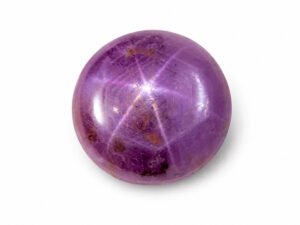
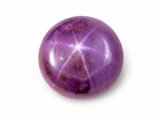
Ratna Gems stocks the first three rows. Buyers whose charts call for a larger Ratti weight than faceted ruby is practical at should look at Star Ruby (Sitara Manik), which is the same species and the same planet at a lower rate, or at the recognised Surya upratnas set out in our gemstone buying guide. Ruby and Blue Sapphire are both corundum, which is why the treatment vocabulary on this page applies to both. Our Bangkok Manik starts around ₹500 per carat with the treatment named on the product page, African Ruby runs from roughly ₹2,300, and unheated Mozambique from roughly ₹4,000.
There is no ceiling on ruby. Unheated Burmese pigeon’s blood stones have sold above US$1,000,000 per carat at auction, and no dealer anywhere stocks the top of the category — that material moves privately between collectors and never reaches a retail shelf. The figures you see quoted online as “the ruby price” are almost always drawn from this rarefied end, which is why so many buyers arrive convinced that any ruby under a lakh a carat must be false. It is not. Decide what you can comfortably spend first, then buy the best colour available inside it. A clean, well-saturated stone in your budget serves its astrological purpose; an unaffordable one serves nothing.
Step 6: Verify Treatments (Heated vs. Beryllium Diffused vs. Glass-Filled)
Over 95% of natural rubies undergo simple heat treatment to improve color and dissolve rutile silk. However, you must avoid deceptive treatments:
- Lead-Glass Filled Rubies (correctly called composite ruby): heavily fractured corundum that would otherwise be unsaleable, filled with molten lead-bismuth glass. Major laboratories do not grade these as ruby at all — GIA reports them as a “manufactured product”, because a substantial share of the finished stone by volume is glass rather than corundum. They are extremely unstable, fragile, and have a hardness of only ~6. Exposure to household acids (lemon juice, vinegar) or a jeweler’s torch will turn the filler white or melt it. Under 10x magnification, they display Trapped Gas Bubbles and the “Flash Effect” (iridescent blue/orange flashes in cracks). They carry almost no market value.
- Beryllium Diffusion: High-temperature heating (>1800°C) with beryllium to force chemical color changes. Beryllium is not naturally present in corundum. This lattice diffusion can only be detected via advanced laboratory testing, such as LA-ICP-MS (Laser Ablation Mass Spectrometry) or SIMS.
Step 7: Demand a Lab Certificate from a Reputable Seller
Always buy from a trusted seller who provides a certificate from an independent, recognized gemological laboratory. The certificate must state whether the ruby is natural or synthetic, its exact treatment status (heated, unheated, or glass-filled), and its geographical origin.
Why Trust Ratna Gems™ for Your Ruby?
At Ratna Gems™, we are committed to providing authentic, high-quality astrological gemstones with complete transparency. We are your trusted source because we offer:
- Certified Authentic Rubies: Every Manik is certified by a recognized lab, detailing its origin and treatments.
- Transparent and Honest Pricing: We offer competitive prices for genuine Rubies with full disclosure on quality and origin.
- Unmatched Customer Support: Our experts are here to guide you, and our 7-day return policy ensures your complete satisfaction.
Frequently Asked Questions
Which is the best origin for Ruby?
Historically, Burmese Mogok rubies are the gold standard due to their strong red UV fluorescence and fine rutile silk velvet effect. However, Mozambique rubies from Montepuez have emerged as the premier modern alternative, offering exceptional eye-clean clarity and vivid crimson saturation at a more competitive price.
What is the difference between Ruby and Red Spinel?
While they look similar and were historically confused (such as the famous “Black Prince’s Ruby” in the British Crown Jewels, which is actually a red spinel), they are mineralogically distinct. Ruby is a corundum (hardness 9, specific gravity ~4.0) while Spinel is a magnesium aluminum oxide (hardness 8, specific gravity ~3.6). A gemological lab can easily distinguish them using refractive index or Raman spectroscopy.
What is the difference between a heated and a glass-filled ruby?
Heat treatment is a stable, permanent, and universally accepted method to improve color and dissolve rutile silk. Lead-glass filling is a non-permanent, unstable treatment in which fractures in heavily included corundum are filled with lead-based glass. Glass-filled rubies are fragile, vulnerable to mild acids (lemon juice), and hold very little resale value.
How should I care for my Manik jewelry?
Natural and standard heat-treated rubies are highly durable (hardness 9) and can be cleaned with warm, soapy water and a soft brush. However, lead-glass filled rubies must never be exposed to acids, steam cleaning, or ultrasonic units as it will melt, etch, or shatter the glass filler.